
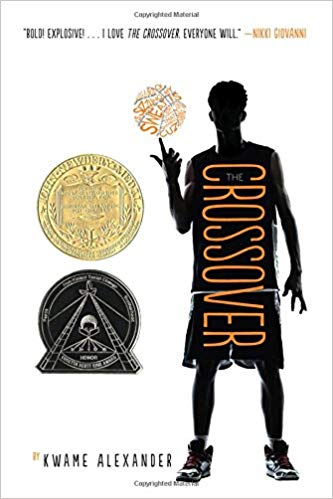
Book: The Crossoverby Kwane Alexander, 2015 Newberry Medal Winner & 2015 Coretta Scott King Honor Award Winner
Type of book: This book experiments with a lot of different types of poetry. The book is mostly written as a narrative (telling a story) poem in free verse – lack of rhyme and cadence, but the author also has chapters that are written in a concrete style with words flowing across the page and lyric poems where there is rhyme and description. This book is unique in that it uses a lot of different styles throughout.
Author overview: Kwane Alexander is an award winning author of 32 books who interestingly enough, began to hate reading when he was younger because he says he was forced to read things that he didn’t want to read. Alexander explains how he got into writing poetry: “Nobody said, give him a book he’ll love; so I was much like Nick in booked. I didn’t like books at all,” (2018). Alexander read fun books when he was a kid, and he wanted to make reading fun for others. As Alexander made his way back to loving reading through poetry, he wanted to be able to share that experience with others. Alexander explains: “They [poetry books] had complete stories in five lines… And I think that’s why I write novels in verse now, because I love all the white space. I love the rhythm, the rhyme and figurative language and I like how you can say so much in so few words. I like to tell a stories that are powerful and emotional in a few lines,” (2018). This shines through in his work as he is able to tell a captivating story in fewer words than would be expected in a “regular” novel.
Summary of the book: The Crossover is a book about a young boy’s love affair with basketball, and the interwoven feelings of being a teenager. Josh – lovingly referred as Filthy McNasty by those around him for his sick basketball skills is the Most Valuable Player on his team, but he’s also dealing with life around him. His twin brother has his first girlfriend and Jordan feels neglected and abandoned by him, and also: his dad is really, really, sick. This book explores family dynamics through the eyes of a young basketball star and what it’s like to grow up in a family that lives and breathes education (and basketball) at the same time.
Connections:
Poetry
Alexander uses many different types of poetry throughout The Crossover. The very opening page of the book is a lyric poem that draws the reader in instantly – even the words are written in ways to make the reader excited about what is about the happen: bolded, enlarged, italicized, and moving down the page, we get exposed to what this book is going to be like. Alexander draws us in with music in language when he says: “At the top of the key, I’m MOVING & GROOVING, POPing and ROCKING – Why you BUMPING? Why you LOCKING? Man, take this THUMPING. Be careful though, ‘cause now I’m CRUNKing CrissCROSSING FLOSSING flipping and my dipping will leave you SLIPPING on the floor, while I SWOOP in to the finish with a fierce finger roll… straight in the hole: Swoooooooooooooosh,” (2014, pg. 3). With an opening chapter like that, it’s impossible to not be hooked.
Alexander varies the structures of his chapters. Though most are free verse, occasionally they rhyme. The chapter “Ode to My Hair” starts with a different line each time and every second line ends in it. The way it’s written allows the reader to hear it in Josh’s voice, as if he were rapping it to us. “If my hair were a tree / I’d climb it. I’d kneel down beneath / and enshrine it. I’d treat it like gold / and then mine it. Each day before school / I unwind it. And right before games / I entwine it,” (2014, pg. 33). This unique style allows us to see into Josh’s mind and understand how important his hair really is to him, so when his brother accidentally ruins it, we can truly and deeply understand why he is so upset.
There is only one chapter in The Crossover that rhymes, and this detail stands out. The second chapter, “Josh Bell” when we are introduced to the main character and how he got his name, is the only chapter that truly rhymes (versus rhyming every other line with the same word: “it”). We’re introduced to Josh as, “If anyone else called me / fresh and sweet, / I’d burn mad as a flame. / But I know she’s only talking about my game. / See, when I play ball, / I’m on fire. / When I shoot, / I inspire. / The hoop’s for sale, / and I’m the buyer,” (2014, pg. 4). The fact that this is the only chapter that rhymes makes it stick in the reader’s mind. Because this chapter is about how Josh got his nickname Filthy McNasty and his nickname is an important and common theme throughout the book, it makes sense that Alexander wouldn’t want us to forget it.
Alexander is a master of writing a captivating story in just a few words, but that doesn’t mean that any of the details are lost. Josh’s parents care a lot about his education – his mother is a PhD and Assistant Principal of the school he attends, and his love of reading and writing shines through in his extensive vocabulary. Alexander’s precise vocabulary shows exactly how important education is to Josh, and how smart he is. Josh introduces us to a lot of words that are important and impactful to him, and frames them like a dictionary where he gives the pronunciation and part of speech, and then explains what the word means and what it means to him. This gives us really important insight into who Josh is as a person, and draws us into his character and story. He introduces us first to “crossover” which is fitting as his life is basketball, but he also gives us: “calamity”, “patella tendinitis”, “pulchritudinous”, “hypertension”, “ironic”, “tipping point”, “churlish”, “profusely”, “estranged”, “myocardial infarction”, and finally “starless”. All of these words have very important meanings to Josh and move along the plot, all while giving us a distinctive view into who he is a person. Josh is attempting to make sense of the world in one of the best ways he knows how – through words.
Alexander also use a lot of figurative language which helps to develop the characters in the story and also helps us to imagine Josh’s world as he sees it. When Josh describes his feelings during a game, he says: “My stomach is a roller coaster. My head, a carousel. The air, heavy with the smell of sweat, popcorn, and the sweet perfume of mothers watching sons,” (2014, pg. 24). We might not know how it feels to love basketball with every fiber of your being and still feel nervous while playing, but Alexander skillfully relates it to something we might understand – being on a roller coaster and the nervous excitement that comes with being at a carousel. His parents speak this way too, with his dad proclaiming, “We beat those boys like they stole something, he adds,” (2014, pg. 63) and his mother asking his father, “You love me?” and him replying, “Like summer loves short nights,” (2014, pg. 74). Josh even reminds us, “…just because your teammate gets fouled on a lay-up doesn’t mean you shouldn’t ever drive to the lane again,” (2014, 123) and describes not having a girlfriend and that feeling of longing as, “I’m still hungry, and right about now I wish I had an apple of my own,” (2014, pg. 120). Alexander takes concepts that might be unfamiliar and uses rich similes and metaphors to connect them to things the reader will know and understand, providing us a much deeper understanding.
Multicultural literacy
Alexander does an absolutely incredible job of smashing stereotypes from the very beginning of the book to the end. Josh is a young black teenager who loves to play basketball, and there are many stereotypes in America about what that might look like. A common stereotype portrays black children as growing up without a father figure: “The myth is that most black fathers are absent from their homes — or that most black children grow up without their fathers. Both of these claims are false. Still, the myth shows up in tweets carrying misleading statistics, often from people blaming fatherlessness for numerous problems facing the black community. It also comes from officials, such as Dallas police chief David Brown who said, “70% of the African American community is raised by single women,” (Lves, 2017). Alexander smashes this stereotype in The Crossover. Not only does Josh have a fully together family, his dad is actually a stay-at-home parent. Josh’s dad says to him, “My playing days are over, son. My job now is to take care of this family… honestly right now I’m fine coaching this house and keeping up with you and your brother,” (2014, pg. 17).
Alexander also shatters the stereotype of the young black male as a “thug” when his mother says things to him like: “Boys with no self-control become men behind bars,” (2014, pg. 138), “I’m confused, Josh. Make me understand. When did you become a thug?” (2014, pg. 139) and “Boys with no discipline end up in prison,” (2014, pg. 139). His family shows that they will not accept his behavior, will not let his character be decided by those around him, and that he must be an upstanding person in order to earn respect. His mother knows how the world sees him and his future, and she knows how important it is to make sure that he knows and understands that it will not be tolerated.
Alexander shows us over and over throughout the book that a young black boy who loves basketball is not any of the things that the world might have already decided he is. He is educated and so are his parents, he is part of a loving and tight-knit family, and he won’t be a thug. Although Josh may have to work harder than some to prove this – his family will make sure that he does. Alexander works hard through The Crossover to show us that love and support go a long way, and sheds a positive light on a community that isn’t always portrayed that way. In the light of the not so distant events of violence throughout black communities in the United States: the Ferguson riots in 2014, the riots over Freddie Gray’s death in 2015, Alexander asks us through his writing to consider another story. Without actually asking us to do so, we consider the Black Lives Matter movements and Hands up, don’t shoot and what that really means to a community of people who must rise up to fight the stereotypes that are so often pushed on them.
References:
Alexander, K. (2014). The Crossover. Boston, MA: HMH Books for Young Readers.
Drabble, E. (2018, April 25). Interview with The Mac – Kwame Alexander. Retrieved July 5, 2019, from https://www.booktrust.org.uk/news-and-features/features/2018/april/interview-with-the-mac—kwame-alexander/
Levs, J. (2017, July 27). No, Most Black Kids Are Not Fatherless. Retrieved July 05, 2019, from https://www.huffpost.com/entry/no-most-black-kids-are-no_b_11109876


 Adventures in Children's Literature