
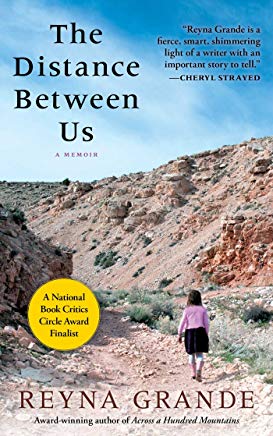
Book: The Distance Between Us by Reyna Grande
Book type: Autobiography
Author overview: Reyna Grande is an award-winning author who grew up in Iguala, Mexico and later immigrated to the United States illegally when she was just 9 years old. Grande was raised by her grandmother in Mexico in absence of her mother and father, who both left separately to go to El Otro Lado – the other side – The United States of America. After growing up in extreme poverty and seeing how difficult life had become for her mother, father, and eventually her siblings whom she crossed the border with, Grande understood deeply the importance of education, especially when living in America. Grande was the first in her family to graduate college, getting her degree from the University of California, Santa Cruz. Coming to the United States as a Mexican immigrant, Grande struggled with the experience of not knowing the native language of the country she had come to. Grande found herself in the experiences of other multicultural authors, and found solace also in her community college in Pasadena, remarking: “As Diana held my hand, I realized I had been wrong – there are heroes in real life,” (2016, pg. 306).
Summary of book: The Distance Between Us is a beautifully written memoir about the real life experiences of author Reyna Grande. Written in two distinct parts, Grande masterfully expresses the deep longing that she felt being left in Mexico by her father when she was a toddler and then her mother a few years later, being raised by her family in their absence, and then in part two, her experiences in America and confronting the fact that life in El Otro Lado was not what she imagined it would be. This heart-breaking book chronicles what it feels like to be left behind and then later, what it felt like to be a part of a family that never quite felt like home. Although this book seems to radiate sadness, this book is an important look into what it feels like to be promised a better life, and coming to terms with the sacrifices that have to be made to make that better life a reality.
Connections:
Multicultural & critical literacy
From the very beginning, Grande takes us inside of the mind of herself as a young child, introducing us to what it is like to grow up in devastating poverty. Grande lives in squalor; she has no running water, is constantly infested with lice, threatened by scorpions, her brother infected with tapeworms. Grande introduces us to the mindset of those around her that dream of living in America and what it would be like, her aunt proclaiming: “’El Otro Lado is a beautiful place,’ my aunt said. ‘Every street is paved with concrete. You don’t see any dirt roads there. There’s no trash in the streets like here. There are trucks that pick up the trash every week. And you know what the best thing is? The trees there are special – they grow money. They have dollar bills for leaves,’” (2016, pg. 38). Her aunt doesn’t believe that money literally grows on trees in America – but she introduces us to the belief that in America, getting out of poverty is so much easier than it is in Mexico. Grande also shows us the way that religion shapes her community – her grandmother believing that her being left handed was “the hand of the devil and I was evil for using it,” (2016, pg. 43), her own belief that, ‘”Mago, you shouldn’t eat things from the ground. They’re bad. They’ve been kissed by the devil,’” (2016, pg. 45).
Grande takes us inside of her world – giving us the powerful imagery to understand why someone might do what her family had done, the reasons that they would feel so desperate to escape that they would leave their family behind. Those who have never experienced what Grande lived every day: “I saw the banks of the canal lined with trash, the debris floating in the water, the crumbling adobe houses, the shacks made of sticks, barefoot children with bellies swollen with tapeworm, the piles of drying horse poop on the dirt road, the flea-bitten stray dogs lying under the shade of trees, flies hovering above them…” (2016, pg. 58) can begin to comprehend why someone would risk everything to leave. The reader can start to grasp what Mami means when she says, “’But no poverty here can compare to the poverty we left behind,” (Grande, 2016, pg. 213). Grande takes us into her world giving us a viewpoint we wouldn’t have unless we grew up in Mexico ourselves. Even though life is not what imagined it would be: “We no longer had to wash our clothes in the dirty canal water, nor scrape our knuckles raw from scrubbing our dresses on the washing stones. And we didn’t have to lay our wet clothes over rocks until they were hard and stiffened by the sun, which left them smelling and feeling like cardboard,” (Grande, 2016, pg. 191).
Immigration is a hot topic in America today, and Grande allows us to see the experiences that would make a person cross into the United States illegally, and how high the stakes really are. We follow the story of a young girl who just wants to be with her family – who has spent many years separated from those that she loves. Grande is able to show us what would make someone want to leave everyone behind, even if the life that they’re living is very different than the one they were promised. Grande shows us how dangerous and scary a border crossing really is – three young children hiding in bushes, getting caught by la migra, worrying about being shot out in the open, attempting multiple times only to finally escape in the middle of the night. She explains through the eyes of a child the reality of what will happen if they don’t make it: “I thought he was asleep, but when I got closer to him, I saw the flies buzzing over him and the big bump on his forehead,” (2016, pg. 135). Even after witnessing death: Grande knows that she must make it across or she will have to live without her big sister, the one person that has never left her, and who took care of her and truly loved her even when no one else was willing to do it.
Although Grande is willing to risk it all to leave and be with her family, she offers us a chance to see both sides of her perspective, and the love of the place that she called home even when it felt at times impossible to do so. She says: “I saw that [poverty], but I also saw the velvety mountains around us, the clear blue sky, the beautiful jacaranda trees covered in purple flowers, the bougainvillea crawling up fences, their dried magenta petals whirling around in the wind. I saw the cobblestone street leading up to the beautiful La Guadalupe church, papel picado of all colors waving over the street. “Don’t you think there’s beauty here too?’” (Grande, 2016, pg. 58). Throughout the whole book, Grande shows us what it would be like to be someone who dreamed of something else, who also struggled with fitting in and adjusting to that new life, and what it is truly like to leave your old life behind. As she attempts to learn English, frustrated by the fact that she has to read books suitable for Kindergarteners, as she tries so hard to do something, anything that hasn’t been done by Mago first, as she does everything and anything she can just to desperately get her father to be proud or have someone pay attention to her, we’re drawn into what it would be like to be a young girl just trying to find her place.
I was instantly drawn into Grande’s story, because of how shocking but also believable it is. We’re told the story from a child’s point of view, starting almost at the beginning of Grande’s life when her mother leaves her to go to Mexico when she is only five years old. Grande tells us the story in a simplistic way, but it works for this story because the main character is a young child. At the same time, she draws us into young Reyna’s story and there are parts of her experience that anyone can relate to. Even though the average reader would not have the same dire experiences as Reyna in the book, the average person can relate to her feelings of distress at being away from her parents, being teased by other children, and her deep love of Mago (her protector). Grande’s story would seem outlandish to an outsider if her descriptions weren’t so powerful, and if immigration to America weren’t still such a hotly debated topic in the United States today. A father and daughter duo made national news just recently when their bodies washed up on the coast of Texas; The New York Daily News reported “The two tragically made headlines after a photo of them face down in the water caused both heartbreak and horror around the world, exemplifying the risk families face when leaving their homes for a better life. It was captured by journalist Julia Le Duc. Martínez and Valeria were swept away by the current between the banks of Matamoros, Mexico and Brownsville, Texas,” (2019). Although they were from El Salvador and not Mexico, this article alone from June 30th of this year proves that the story of a father and his daughter trying to escape the life they have to seek a “better” one in America is not uncommon in today’s world. Grande’s book takes place in the 1980s, but the Department of Homeland Security estimates that from 1990-2000 “…the total unauthorized immigrant population residing in the United States in January 2000 was 7.0 million. The total population estimates presented here are somewhat higher than INS’ previous estimates. In its last set of estimates, INS estimated that the population was 5.0 million in October 1996; the new estimates produced a total of about 5.8 million for the same date. Estimated population growth was variable in the 1990s; on average, however, the population grew by about 350,000 per year from 1990 to 1999, about 75,000 higher than INS’ previous annual estimate of 275,000 for the 1990s… As expected, California is estimated to have the most unauthorized residents in January 2000, about 2.2 million, or 32 percent of the national total,” (2019). Based on these numbers, and the horrors that appear in the news weekly, especially under the Trump administration – though Grande’s story may initially seem unbelievable to an outsider, it is an experience that is wholly authentic, and one that readers everywhere need to know and hear.
This book is an important story for many to read, but especially for those who might struggle to understand why people would enter the United States illegally, and those who have family in other countries. I work in a school that is comprised of mostly Hispanic students, and the majority of these students have family in Mexico. Many readers would have different interpretations and different constructions of knowledge after reading this book. A child with parents who support President Trump and the Trump Administration and the building of a wall between Mexico and the United States could have a shift in perspective after reading Grande’s story. They may better understand why someone would risk it all to come to the United States. Those with family in other countries who have felt abandoned might better understand why their parents would have made the decisions they made. Those who have no experience with these topics may be able to gain empathy for those who are going through it, and a deeper understanding of varying cultures and cultural norms different than their own. As a teacher, after reading Grande’s book I more fully understood what it would be like to be a student in America learning English for the first time. Grande laments: “I had always liked to read in Mexico, but here in this country the books for kids my age were very difficult for me to read in English. The only books I could read were for kindergarteners! Books with big letters and lots of pictures. I loved looking at the pictures, but the stories weren’t very interesting,” (2016, pg. 202). Grande pulls me into her mind and what it would be like to be a student who was very bright in her home language, but had no way to show it, and her feelings of disappointment when her teacher doesn’t even bother to read the story she wrote because it’s written in Spanish.
Grande’s book is an incredible example of a book that can be used to promote critical and multicultural literacy. Grande puts you directly into her own shoes and how she feels about everything happening around her, but she also allows you to see the viewpoints of those around her. When Mago gets in a fight with a girl at school, Grande says: “Maria didn’t know that Carlos wasn’t trying to protect Mago. She didn’t know that the previous week Mago’s heart had been broken, and ever since then she’d been itching to punch something or someone. Maria didn’t know that only the day before, Mago had hit me because I’d taken her rubber band without permission to put my hair up into a ponytail. And shed punched Carlos in the stomach for spilling water onto her math homework,” (2016, pg. 200). She shows us Mago’s life, the life of those back in Iguala too when she goes home and sees them still living in poverty – her old friends married and with children, and she shows us insights into Mila, her father, and her brother as well. She tells us about Mago’s ridiculous debt acquired trying to fit in, her father’s inability to show her love the way she wants and needs because of his upbringing, her brother Carlos dropping out of college to “become a man.” All of these scenarios invite us to look into the cultural norms where Grande grew up, and to think about what it would be like to live the way she did, and the way those around her did.
Grande’s book never tells us what we should think about issues of inequality in other countries (or in America), those in power who make these situations a reality, whether or not we should be in favor of literal border crossing, gender norms, abuse, or anything else – but by inviting us into the minds of little Reyna and her experiences and those around her, she asks us to think about them and draw our own conclusions.
References:
D. (2019, June 06). Estimates of the Unauthorized Immigrant Population Residing in the United States. Retrieved July 03, 2019, from https://www.dhs.gov/immigration-statistics/population-estimates/unauthorized-resident
Grande, R. (2019). Award winning author and inspirational speaker. Retrieved July 3, 2019, from https://reynagrande.com/
Grande, R. (2016). The Distance Between Us. New York: Aladdin, an imprint of Simon and Schuster Childrens Publishing Division.
Torres, E., & Torres, E. (2019, July 01). Bodies of migrant father, daughter who drowned in Rio Grande returned to El Salvador. Retrieved July 03, 2019, from https://www.nydailynews.com/news/world/ny-bodies-migrant-father-daughter-returned-el-salvador-20190701-lcbfwrncfbdupd3ploc2maiir4-story.html
 Adventures in Children's Literature