
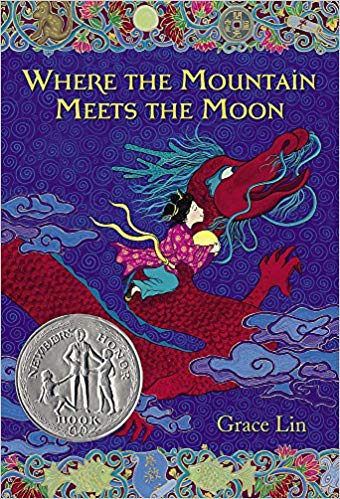
Book: Where the Mountain Meets the Moon by Grace Lin, winner of the Newbery Honor Award
Book type: Modern fantasy
Author Overview: Grace Lin is a New York Times bestselling author who recently won a Caldecott Honor for A Big Mooncake for Little Star. Grace originally dreamed of being a figure skater, but after realizing her own talents as an artist, she decided to become an artist instead. Lin is the illustrator of more than a dozen picture books for children and has been a published author since 1999. Her own website states: “While most of Grace’s books are about the Asian-American experience, she believes, ‘Books erase bias—they make the uncommon everyday, and the mundane exotic. A book makes all cultures universal,’” (n.d.).
Book Summary: Where the Mountain Meets the Moon tells the delightful story of Minli, a young girl living in a remote village in China. Minli’s family is very poor as is her entire village, because they live at the base of Fruitless Mountain. Fruitless Mountain is barren, and her parents spend long days working in the mud to little avail. They have just enough food to get by, a very small home to live in, and two coins to their name. Minli’s father loves to tell stories, and one story in particular catches Minli’s attention. He tells her of the Old Man of the Moon, a powerful magistrate who holds the Book of Fortune. The Book of Fortune holds the key to everyone’s predetermined fate – but the book can be changed. When Minli realizes that a person’s fate can be changed by asking the Old Man of the Moon a question, she sets off on her journey to find him and ask him to help her family. This book explores what it is like to live in poverty, and the kind of risks someone might take to try to escape it.
Connections:
Strong, believable characters
In Where the Mountain Meets the Moon, Grace Lin writes a heart-warming story full of fantastical characters. Although we meet many characters outside of the ordinary – talking goldfish, a dragon born from a painting, various stationary objects with thoughts, feelings and emotions, and even some mischievous monkeys – the main characters are not only strong and believable, they are familiar and relatable too. Our main character Minli only wants what is best for her family, and she believes strongly that what is best is changing their fortune. Her family is very poor and so are those that surround them, and she wants her family to be happy. Her father loves to tell stories, and Lin says, “What kept Minli from becoming dull and brown like the rest of the village were the stories her father told her every night at dinner. She glowed with such wonder and excitement that even Ma would smile, though she would shake her head at the same time. Ba seemed to drop his gray and work weariness – his black eyes sparkled like raindrops in the sun when he began to tell a story,” (2009, pg. 3). Minli is tired of being caked in mud every day and how tired her parents are as well. They work from sunrise to sunset, and her mother complains constantly about their poor fortune. Although Minli and her father are placated by his stories, Ma is not. “’The Old Man of the Moon! Another story! Our house is bare and our rice hardly fills our bowls, but we have plenty of stories.’ Ma sighed again. ‘What a poor fortune we have!’” (Lin, 2009, pg. 9).
Minli is a hard worker, but she is young and full of dreams and tired of working in the exhausting heat, and she grows sad for her family and their meager possessions. We are reminded that Minli is still but a child when she spends half of her family’s fortune (just two coins in a bowl that she was given at birth) on a goldfish that a peddling man tells her can help her change her fortune. How naïve is she to think that this could be true! Minli is a relatable character – she is kind and compassionate, and although her adventures are not the ordinary, every reader can find themselves inside her – a girl who just wants what is best for her family and a better life. We see Minli grow over time, from being a character who just wants riches for her family, to one who realizes that friendship and those we come to love mean more than jade or gold ever could. We see this when Minli worries over Dragon when he is attacked by the Green Tiger, but most importantly when she finally makes it to the Man of the Moon and decides to not ask him a question about her own family and their riches, but rather about Dragon and why he cannot fly. Minli realizes when she gets to him that, “Fortune was not a house full of gold and jade, but something much more. Something she already had and did not need to change. ‘I didn’t ask the question,’ Minli said again and smiled, ‘because I don’t need to know the answer.’” (Lin, 2009, pg. 259). Minli realizes the importance of family, love, and friendship and understands finally that she does not need to change her fate. Rather, she needs to look inward and be thankful for what she already has (and had all along!)
Minli’s parents shine as strong characters as well, and even those without children can put themselves in their shoes and see their despair at the loss of Minli. Minli’s mother who speaks constantly of their poor fortune exclaims when she realizes Minli is gone: “’I spoke too soon,’ Ma cried. ‘Our fortune is now the worst, for our only daughter is gone!’” (Lin, 2009, pg. 37). We watch Minli’s parents grow over time, as Ma begins to realize that their fortune really is shaped by love and family and not by the money in their pockets or the rice in their bowls. Her mother goes from blaming Minli’s father for telling her fantastical stories to realizing that it was her and her complaints of their fortune that really set her to run away. Even though Minli is the main character, we see such growth in Ma as well as she says, “She was at last able to see that her daughter’s laughter and love could not be improved by having the finest clothes or jewels, that joy had been in her home like a gift waiting to be opened,” (Lin, 2009, pg. 253). Lin’s character development is strong, and we are able to see and understand how Ma would feel the way she did at the beginning of the book, and also how her viewpoint changes overtime and she is able to see what is truly important through the lens of what she had lost.
Six basic fantasy motifs
Tunnell, et al. explain: “Even though all modern fantasy stories contain some sort of magical element, some stories have a higher fantasy quotient than others. Madsen (1976) identifies six basic fantasy motifs; if a story contains all six, it is either a classic fairy tale or an example of modern high fantasy,” (2016, pg. 126).
Lin’s book contains all six. It has elements of magic – the king of the City of Bright Moonlight turning the peach pit into a peach tree that actually consisted of the merchant’s peaches, strings of destiny, the rope bridge made from the kite strings, magical tea that cured the wounds of the Green Tiger, and Moon Rain. Where the Mountain Meets the Moon also contains other worlds; rivers where goldfish can talk and aspire to get through the Dragon Gate, a forest full of greedy monkeys that want all of their peaches for themselves, the Inner and Outer City of the City of Bright Moonlight, and most importantly of all – Never-Ending Mountain, where the Man of the Moon lives and where Wu Kang must try to cut down a magical tree that continues to regrow, every single night until he learns his lesson about patience. The story also contains good versus evil – Green Tiger full of angers tries to wreak havoc on the Da-A-Fu twin’s village, and he asks for children to be sacrificed to him or else he will continue to kill livestock and haunt the town with his evil. However, the twins knew that they could not fight the tiger’s anger with anger of their own, and instead turned his anger inward on him, forcing him down into a well and saving the town from his pain. We have heroism as well, as Minli is called to adventure by her talking goldfish, ventures in the wild to face danger (the monkeys and more!) protected by Dragon, matures over time learning the importance of friendship as she meets and comes to love Dragon, the boy with the oxen, the King, and the Da-ah-Fu twins and misses her family deeply, and then finally returns to her village after meeting the Man of the Moon and learning how she can help Dragon to fly. We have many special character types ranging from Dragon who came to life from a painting, the Man of the Moon who holds the Book of Fortune, Green Tiger, and talking door knockers. We see fantastic objects as well – a book that holds people’s fates and the string of destiny (both borrowed lines) most notably.
Critical Literacy
Without telling us explicitly to do so, Grace Lin asks us to carefully think about poverty in our society, and the kinds of things that not having what we desire or see to be what we need might make a person do. Minli, feeling that she is missing out on the riches of the world – driven by her mother who feels the same – is willing to leave her village and family and venture out into a world she does not know to ask a mythical person whom no one has ever seen or spoken to, in order to change her family’s fate. This book asks us to look at our society – one that is so often framed by wanting more. Lin examines this throughout the entire book by introducing us to characters who invite us to think deeply about what it means to be poor or to be rich. When Minli meets the orphan boy with the oxen, she feels sad for him, thinking that he has nothing. However, “As Minli looked at the buffalo boy, aglow with happiness against his poor surroundings, she saw it was enough for him. More than enough, as the smile that kept curling up on his face told her,” (Lin, 2009, pg. 114). The orphan boy laughs and won’t accept Minli’s money – he has plenty. He has a friend and his buffalo, and he loves them, and that is enough for him and more than any money could ever buy. Lin, without telling us to do so, invites us to look at life through another lens. What is it like to have what some would consider nothing and still be content? Is it possible to be rich with friendship and love instead of money? How do those in power shape our realities into thinking that what we need is money and valuables in order to be happy? How does capitalism shape how we feel about what we have and what we don’t have?
We see this theme over and over again told through Chinese proverbs, which Lin explains in the back of the book are partially real and partially imagined by her. Asian American’s voices are often silenced – we don’t see a true representation of Asian Americans in film or in literature, and reading these powerful folktales like the one of Wu Kang – a man who had more than anyone could ever need – a comfortable life and loving family but always wanted more asks us to think about why we don’t know more about Asian culture and these beautiful and thought-provoking stories. Even the Da-ah-Fu twins ask us to think about what our society and culture values – as their ancestors home was in threat of being destroyed by the greedy magistrate who wanted to know the secret to happiness, which we find out later was simply thankfulness. Lin asks us to think about this – why as a culture are we always trapped in this feeling of wanting more and how can we become more grateful for what we already have? Can we not be rich with love and family?
This book is a truly incredible book for inviting children to take a look into lives we don’t usually see – poor villagers in China – and asking what it really means to have enough. Should we feel sad for those we feel don’t have enough, or do the secrets to happiness really lie deep in the heart?
References:
Lin, G. (n.d.). Long Author Bio. Retrieved June 29, 2019, from http://www.gracelin.com/content.php?page=press_authorbio
Lin, G. (2009). Where the Mountain Meets the Moon. New York, NY: Hachette Book Group.
Tunnell, M. O., Jacobs, J. S., Young, T. A., & Bryan, G. (2016). Children’s Literature, Briefly (6th ed.). Upple Saddle River, NJ: Pearson.
 Adventures in Children's Literature