
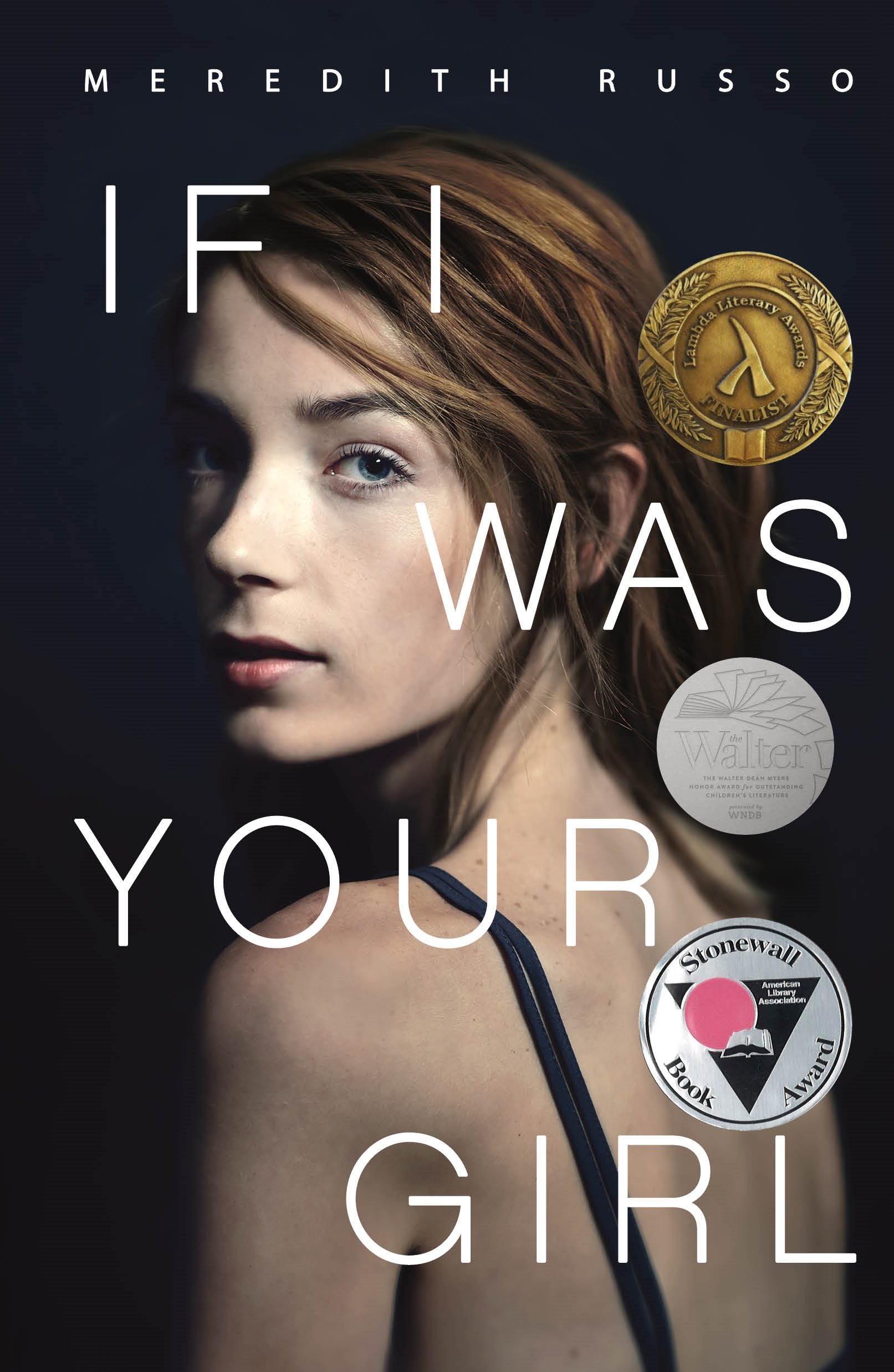
Book: If I Was Your Girl written by Meredith Russo, Stonewall Book Award Winner & Walter Dean Myers Honor Book for Outstanding Children’s Literature
Book type: Contemporary realistic fiction
Overview of the author: Meredith Russo has a very authentic and unique viewpoint to bring to writing a novel about a transgender teenager and the experience of what it feels like to grow up in what feels like the “wrong” body, being that she is a transgender woman herself. Russo’s novel takes place in the deep south and what it would be like to live in a place that is not quite progressive enough to accept you for who you are, which makes sense given that she was born, raised, and currently resides in Chattanooga, Tennessee. Russo began transitioning in 2013, and therefore understands and remembers the experience of coming into her own as her true self, an experience that Amanda goes through in If I Was Your Girl. According to her publisher, Macmillan, “If I Was Your Girl was partially inspired by her experiences as a trans woman. Like Amanda, Meredith is a gigantic nerd who spends a lot of her time obsessing over video games and Star Wars,” (2019).
Summary: If I Was Your Girl is a young adult novel about Andrew, who starts over her life as the person she always wanted to be (and felt in her heart that she was), Amanda. Relentlessly bullied at her old school, Amanda tries to commit suicide. After the attempt, she moves to her father’s house six hours away from the high school she previously went to, full of students and adults alike who don’t know her story, giving her the chance to live her life as the person she always dreamed of being. Amanda’s goal is to keep her head down and just make it through senior year, graduate, and move as far away from the south as possible for college. Amanda’s dreams of “keeping her head down” don’t really pan out though, and she finds herself making new friends, getting her first boyfriend, and actually fitting in for the first time in her life. However wonderful this sounds, Amanda has a deep, dark, secret, and she wonders: who can I tell, if anyone, and when?
Connections:
Contemporary realistic fiction
Russo’s book is an exceptional work of contemporary realistic fiction, falling into the category of a problem novel. Technically, all novels have some sort of “problem” that relates to the story, however: “…the term problem novel grew out of the age of new realism, when taboo topics became acceptable fare for juvenile books,” (Tunnell, et al., 2015, pg. 142). If I Was Your Girl mainly deals primarily with the topic of being a transgender person in society, which includes many subtopics that might traditionally be considered taboo: gender identity, social acceptance, bullying involving emotional and physical abuse, attempted suicide, religious skepticism, drug use, and Amanda’s feelings that her gender identity caused her parents to divorce. Amanda herself deals with a lot of emotional issues, such as feelings of isolation, depression, anxiety, and abandonment; to the point that she tries to commit suicide. These are not topics that would have been acceptable in literature in the past. Tunnell, et al. explains this as, “The harsher parts of life simply had not been given center stage in books for young readers until then [the 1970s]. When the taboos lifted, new books spewed forth problems and realities previously unseen in children’s publishing,” (2015, pg. 140).
Although If I Was Your Girl handles themes that many young readers may not be able to personally relate to, Amanda is a character who experiences many of the things that the average teenager in high school would experience, and she is a relatable character even though she is one going through an experience that most people would not – transitioning from being male at birth to female at 18 years old. Amanda experiences depression, and she places us directly in her shoes when she says things like, “I wondered if Bee knew how privileged she was to be able to feel anything at all, if she knew just how scary numbness could be. How it felt, sometimes, like a darkened room with no way out,” (Russo, 2018, pg. 41) and “I wished I could walk up into the sky and live on some distant planet, far away from the things I was afraid of. I wondered if joy could ever be felt by itself without being tainted with fear and confusion, or if some level of misery was a universal constant, like the speed of light,” (Russo, 2018, pg. 66). Many adolescents in the United States struggle with depression. According to The National Institute of Mental Health Information Resource Center, “An estimated 3.2 million adolescents aged 12 to 17 in the United States had at least one major depressive episode. This number represented 13.3% of the U.S. population aged 12 to 17,” (2018). Those grappling with depression would read this book and feel not alone when reading Amanda’s thoughts, and those who do not would gather authentic insight into what it would feel like to be.
Russo’s book takes place in the Bible Belt South, which is important for themes in the book about what it would feel like to be Amanda in a place where it is generally not accepted to be transgender. However, Amanda’s experiences in high school are often universal. She describes her new school as, “Fluorescent lights buzzed angrily, but for all their fury, the halls were dimly lit. Display cases lined the walls, shelf after shelf of trophies for cheerleading, marching band, baseball, and especially football, with records reaching back far enough that half the team photos were sepia-toned. The red classroom doors bore faded-looking number, and I followed them to 118, the homeroom marked on my schedule” (Russo, 2018, pg. 13). When framed this way, Amanda’s school could be anywhere. Her descriptions of high school classes, parties, football games, trying to make friends, and the feeling of just trying to fit in are universal feelings that resonate with most, if not all young adult readers. Contemporary realistic fiction draws a reader in because it is familiar, it reminds them of their own experiences, and though Russo’s book has undertones unfamiliar to many readers, there are enough similarities for anyone to draw on their experiences and connect to it in their own personal way.
Critical literacy
Russo’s book asks us to take a look into what it would feel like to be a transgender person – someone who is living a life that bends the rules of what many in society deem to be normal and acceptable. Russo does this in very powerful ways; she does not tell us what it would feel like to be a transgender person, but instead invites us into Amanda’s own brain and describes the situations that unfold around her.
The reality is that in many places in the United States, it is not acceptable to be a person who has decided that their birth gender is incorrect, and there are many socially ingrained ideas about what being either gender is supposed to mean and entail. Amanda experiences many micro-aggressions at the hands of people who do not know her own personal experience, and who have these held beliefs. There are many examples of this throughout the book, but one of the situations that stood out the most to me is when Amanda is at a party and she overhears a conversation where a popular boy at the school, Parker, refers to a boy who moved away as “Grant’s little gay boyfriend,” (Russo, 2018, pg. 57). Grant, another students, defends him, and gets a reply of “’Yo Grant,’ he said. ‘The new girl know you’ve got a vagina?’” (Russo, 2018, pg. 58). Parker makes these comments because the boy in question, Tommy, acted and dressed differently than what was considered to be the “norm” where they lived, placing him into a box of being labeled as homosexual. Grants defense of him gives him traits that are societally associate with females: compassion and caring – therefore Parker tries to insult him by calling him a girl, asking him if he has a vagina. Overhearing this, Amanda “…flinched as if I’d been struck. I wondered why people still made comments like that. I wondered when I’d stop caring,” (Russo, 2018, pg. 58). This leads Amanda to reminisce about a time when she was a child and wrote a story about being a woman when she grew up, and how her dad responded to it. Her dad was another person who believed in traditional gender roles – Amanda describes this as “When he tried to do boy things with me he always frowned and stopped, so I did not think he wanted a son really, which was fine because I hated sports…” (Russo, 2018, pg. 61) and “I looked at my shoes and felt myself starting to cry, which was a bad thing because Dad said crying was for girls,” (Russo, 2018, pg. 63). Amanda’s dad believes that boys play sports and girls cry, a view that is held by many still as traditional gender roles dominate our society, which began to cause a rift in what Amanda believed about herself. Russo invites us to think about this from our own perspectives. Seeing into Amanda’s experiences, the reader begins to think about those gender roles, and we can begin to imagine what it would feel like to be someone who desperately wanted to fulfill them to meet their family and society as a whole’s expectations, but continually failed to do so, simply because of who they were as a person.
Russo invites us to think about a lot of ideas that are held in society, such as when Grant is afraid to tell Amanda that he has a beat up car, feeling like not being able to give her a ride will make him “less manly” and how he is afraid to invite her into his home because of his low socio-economic status. Amanda remembers times that she was beat up and called a “faggot” for the way she acted and dressed, Chloe crying the first time she kissed a girl because she grew up thinking that she was the “only person like her” when she realized that she was gay, Anna’s problems with cognitive dissonance coming from her parents strict religious upbringing and her deep love and acceptance of her friends anyway, and her parents coming to terms with the loss of what they thought was their “son” and what it means to instead raise a daughter.
Russo’s character Bee forces us to take a long hard look at what people think and believe, especially in a religious Deep South town, and how many people have to hide who they really are. Bee says things like, “Everybody’s too afraid of going to hell or getting made fun of to be honest about what they want and who they are, so they can’t even really admit what they want to themselves. It’s sad,” (Russo, 2018, pg. 163). Russo never tells us who is right and who is wrong, but instead creates diverse characters struggling with all kinds of issues that revolve around hiding who they really are because of fear of rejection. She asks us to think about dominant structures in society, and what it would feel like to be silenced. Amanda reads the bumper stickers on Anna’s parent’s car that read things like: “JESUS WAS A CONSERVATION, one read, and RIGHTS COME FROM GOD NOT GOVERNMENT; ILLEHAL ALIENS! EXACTLY WHICH PART DID YOU NOT UNDERSTAND? And I CAN’T HELP THAT I’M HOMOPHOBIC… I WAS BORN THAT WAY!” (Russo, 2018, pg. 82). Russo shows us both sides of the story, so that we can understand why different characters believe the things they believe and act the way they act – due to fears of rejection, wanting to fit in with their peers, and their own long held family beliefs. Instead of telling us that one way of thinking is wrong, or one is right: Russo invites us into the lives of many different multifaceted people and allows us to draw our own conclusions.
Without explicitly doing so, Russo asks us to think about those whose voices are often not heard: transgender, homosexual, bisexual, struggling with religion. She invites us to think about why those voices are silenced, while placing us directly in their shoes and showing us what it feels like to be marginalized by those in power. Books written from the viewpoint of a transgender person are not commonplace, and this book provides an excellent alternative account of what it would be like to experience high school. Russo’s book If I Was Your Girl is a social issue book, which Lewison, et al. (2002) describe as, “…books [that] make difference visible, give voice to those traditionally silenced, explore dominant systems of meaning in our society, question why certain groups are positioned as others…” (pg. 3). This book could be used in a classroom in many very meaningful ways. In a safe classroom environment, students could ask questions about why we treats others who behave “differently” the way we so often see, what kinds of systems could be put in place to prevent bullying, what gender identity means, how to be a good friend to someone who is experiencing feelings of isolation or depression, and more. Students can question Russo’s book and the alternate experiences that are not mentioned: what would it be like to be Amanda if she weren’t beautiful and passing as a woman? What is the experience of the transgender teenager who doesn’t have (at least somewhat) supportive parents? What is it like to be a transgender male versus a transgender female, and how would their experience be different than Amanda’s? What is it like to be a teen who cannot afford hormone replacement or gender reassignment surgery? What is it like to be transgender in a place like New York City, versus the Deep South?
Russo’s book lets us in on one experience as a transgender female and those around her, but it invites us to think about other scenarios and experiences as well. Russo’s book gives us a unique perspective on an issue that many of us may not have thought about, if we aren’t transgender ourselves. Russo gives us the power to question dominant viewpoints in society, and it is our job to take our new understandings of the world around us, and transform them into positive change.
References:
Lewison, M., Flint, A. S., & Sluys, K. V. (2002). Taking on Critical Literacy: The Journey of Newcomers and Novices. Language Arts, 79(5).
MacMillan Publishers. (2019). Meredith Russo. Retrieved June 27, 2019, from https://us.macmillan.com/author/meredithrusso/
Russo, M. (2015). Bio. Retrieved June 27, 2019, from https://www.meredithrusso.net/bio
Russo, M. (2018). If I Was Your Girl. New York, NY: Flatiron Books.
The National Institute of Mental Health Information Resource Center. (2017). Major Depression. Retrieved June 27, 2019, from https://www.nimh.nih.gov/health/statistics/major-depression.shtml
Tunnell, M. O., Jacobs, J. S., Young, T. A., & Bryan, G. (2016). Children’s Literature, Briefly (6th ed.). Upple Saddle River, NJ: Pearson.
 Adventures in Children's Literature