
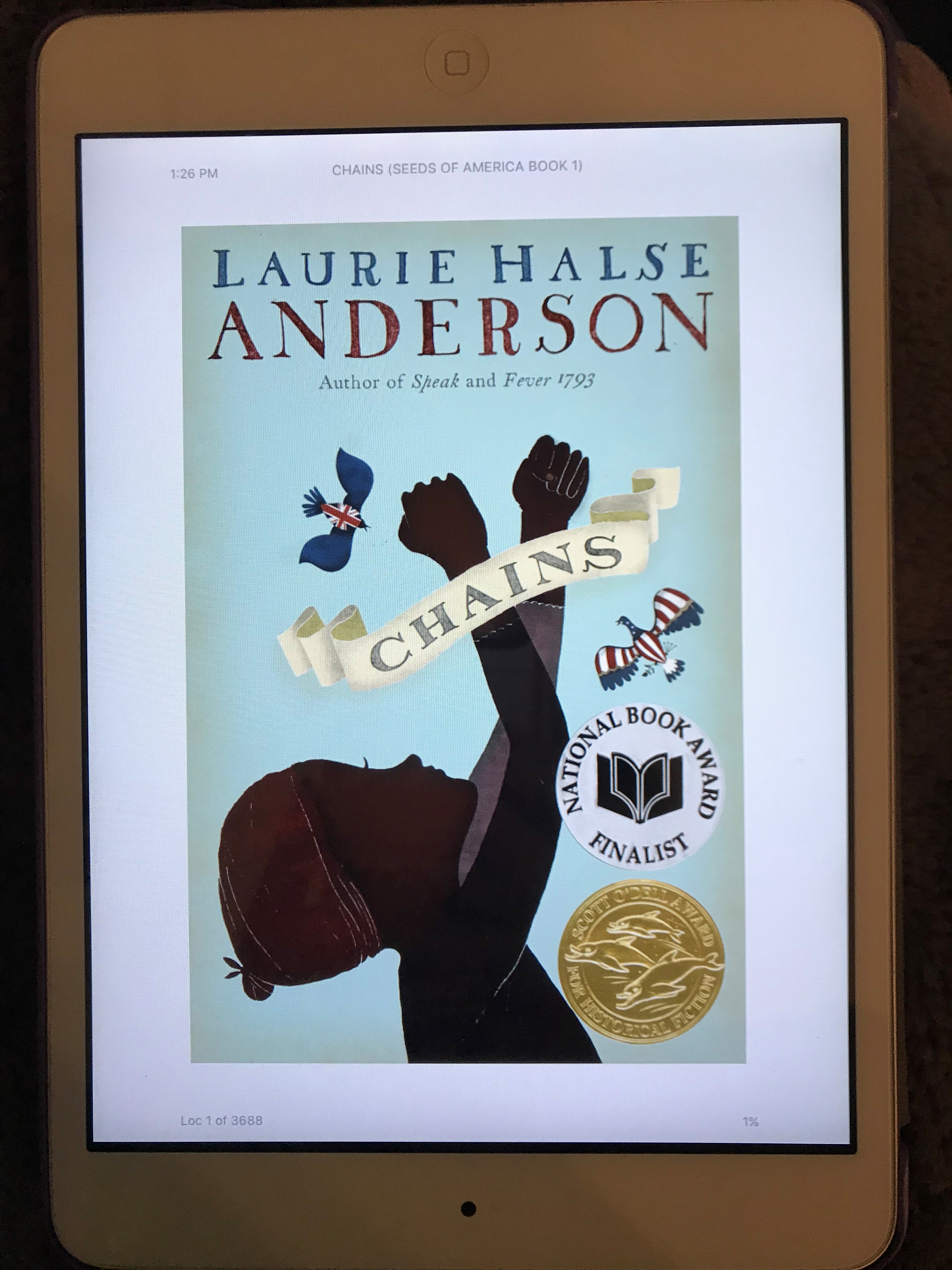
Book: Chains (Seeds of America Book 1) written by Laurie Halse Anderson, Published by Atheneum Books for Young Readers: An Imprint of Simon & Schuster Children’s Publishing Division, 2008, New York: New York
Awards: National Book Award Finalist, Scott O’Dell Award for Historical Fiction
Book type: Historical Fiction
Overview of author: Anderson is a New York Times bestselling author whose books have sold millions of copies throughout her career. Anderson has been nominated and received multiple awards for her books, and has most notably been nominated for the Astrid Lindgren Memorial Award three times. Anderson is a passionate fighter against censorship of books, and has been recognized for this by the National Coalition Against Censorship. Anderson also frequently writes about hard topics including sexual abuse and bullying, and also is known for speaking out about the need for diverse characters in young adult novels. She is a member of RAINN (The Rape, Abuse & Incest National Network) and is on the leadership council. She also writes on her own website that she “lives in Philadelphia, where she enjoys cheesesteaks while she writes,” (nd).
Summary of book:
Chains is a book set during the Revolutionary War in New York City that spans from May 1776 to January 1777. The book centers around Isabel and her sister Ruth, two slaves who original lived in Newport, Rhode Island, who are shipped to New York to live with their new masters, the Lockton’s, after their original owner passes away. The two girls who became orphans after their father was beaten to death and their mother died of smallpox, are alone in the world except for each other. They were supposed to be freed when their owner Miss Mary Finch died, as it was stated in her will that they be, but the papers were lost by her only living relative Mr. Robert who sells them in a bar. The book chronicles Isabel and Ruth’s struggles in adjusting to their new home and life, the tedious work they are to do under a cold and uncaring Madam, and Isabel’s internal conflicts on whether to surrender to the seeming impossibility of ever becoming free versus her need to fight to protect her younger sibling by freeing them both.
Connections:
Anderson is a talented writer, which is obvious from her long list of awards and nominations, but it really shines through in her writing of Chains. A general rule of thumb when determining quality of writing is that the writer is able to show us through writing what is happening in the story, versus explicitly stating facts of what is going on. Tunnell, et al. describe this by explaining, “Where lesser writing tells by summarizing, quality writing shows us what is going on by providing enough sensory detail to allow us to make personal discoveries,” (2016, pg. 25). Anderson does this beautiful, introducing us to characters and settings alike by using descriptive figurative language to describe them, instead of just stating facts. Anderson uses similes and metaphors through the book to explain how characters are feeling, which gives us a much deeper understanding of them as people.
When describing how she felt after her father’s wrongful death, Isabel says, “I thought Momma would shatter like a bowl when it falls off a table… there was lion’s blood on the ground mixed with the dust like the very earth was bleeding, and we left there, we three in Miss Mary Finch’s wagon, and everything in the whole world was froze in ice for near two years after that,” (Anderson, 2010, pg. 11). Instead of saying that Isabel’s mother was sad, or that her dad was a fierce man who died fighting, or that she was depressed afterward, she uses descriptive and figurative language to allow the reader to make those connections herself. The reader knows what kind of crash a dish makes when it falls, they know that lions are known for being fierce and courageous, and they can place themselves in Isabel’s shoes with the vivid imagery that comes with a sentence like “the whole world was froze in ice”.
When Isabel and her sister Ruth are sold in the bar, much to her sadness after a kind woman named Jenny who was a friend of her mother’s unsuccessfully tries to buy her instead but fails, Isabel describes the transaction as, “The thudding sound they [the coins] made as they fell to the bottom reminded me of clods of dirt raining down on a fresh coffin,” (Anderson, 2010, pg. 22). Anderson doesn’t say, “Isabel felt sad.” She introduces us to a much wider range of emotions by reminding us: for Isabel to know the sound of fresh dirt hitting a coffin, she must have already experienced loss and the grief that accompanies it. The reader is then able to feel how Isabel must feel more deeply, as it isn’t just sadness, or disappointment, but a heavy sense of loss and grief for the life she thought she might have but was again, denied.
Anderson uses this figurative language throughout the book when introducing us to new settings as well, saying things like: “The fat moon lit the water like a lantern over a looking glass,” (2010, pg. 25), “There were smaller buildings, too, all crowded shoulder to shoulder, with no room for a feather to pass betwixt them,” (pg. 27), “The windows were all closed, but sun streamed in, heating the room to a slow simmer and bringing forth the ripe stink of underwashed gentlemen,” (pg. 87), and “The air was hot and dripping, as if the city were wrapped in a wool blanket just pulled from a boiling pot,” (pg. 99). All of these descriptions allow us to connect our own personal experiences to what Isabel experiencing. Rather than her simply telling us: “It was hot and humid, and the people inside were smelly” or “New York was a big city with lots of building close to together” she allows us to use our imaginations to think of a small feather not being able to float between them, and a room so hot it felt like boiling water.
The character development of the main character is seen through the various glimpses we get into her thoughts, and the way those thoughts and feelings change over time. Isabel starts off as a girl who knows not much about the Revolutionary War, and doesn’t care much about what side is fighting for what, so long as she can keep her head down and stay out of trouble to avoid being beaten, and to avoid her own sister being hurt. When asked by a neighbor boy to become a spy, she is initially reluctant, worrying about what kind of trouble she could get in and seeing no real reason to fight for any particular cause. However, as Isabel is beaten down (literally, and figuratively) over time, she begins to see the injustices around her, and the action she must take to fight it. Isabel refers to these feelings inside of her as bees, and we hear quite a lot about them throughout the novel. She describes them at first as, “Strangest as all was the hive of bees that had taken up residence inside of me. They swarmed under my skin and gave off peculiar vibrations. The buzzing echoes in my brainpan and crowded out my thoughts. The fire in me burned on and on,” (Anderson, 2010, pg. 150). These comparisons are huge and important, as we begin to see a light turn on in Isabel and her burgeoning desire to do something, anything, to start to fight back. When she feels like she can see a way out, she describes this as: “The bees in my head fell silent and hugged their wings tight to their bodies,” (Anderson, 2010, pg. 165), and when she begins to lose hope as “My bones were hollow and my brainpan empty,” (pg. 186) as if the bees – the strong buzzing force inside of her – had grown quiet. Later still, the bees come back, and she tells us, “I had been invaded. A dim plan had hatched itself in my brainpan without my consent, and I did not much like it,” (Anderson, 2010, pg. 214).
We see a huge change in Isabel throughout the story, from a girl who would keep her head down and accept what happened to her, to a girl who decides to take charge of her own life. A most powerful sentence near the end of the book reads as follows: “She cannot chain my soul. Yes, she could hurt me. She’d already done so. But what was one more beating? A flogging, even? I would bleed, or not. Scar, or not. Live, or not. But she could no longer harm Ruth, and she could not hurt my soul, not unless I gave it to her,” (Anderson, 2010, pg. 246). This awakening inside of Isabel is enormous and shows that she has become someone who will fight for what she believes is right, for herself, for her sister Ruth, and for the neighbor boy Curzon.
We see small glimpses of character development throughout as well, none as big as Isabel’s, but we see Master Lockton give small indicators that he cares for Isabel and Ruth and does not care much for his wife’s mistreatment of them; and we see Lady Seymour on her death bed apologizing for Isabel’s mistreatment and how she wished to buy Isabel as her own to save her from it. We also see character development in Isabel there as well, how instead of feeling warmly toward her the way she did when Jenny tried to buy her back in the bar in Rhode Island, she feels disgust over being seen as property that can be bought and sold. She wonders why Lady Seymour never thought instead to free her.
Anderson’s glimpses into Isabel’s thought give us a strong connection to her as a character. As we see her grow and begin to fight, often making choices that were scary or difficult for her and carried large consequences (beatings, a branding, the threat of being sold), we want to cheer her on the whole way. We’re reminded through the book of Isabel’s caring and kind-hearted nature, as she carries scraps to the prison for Curzon, as she reminices about her lost sister (when she says things like: “Ruth would love this. If we were free and at home in Rhode Island and these were our sheets and our laundry lines and our snow, she’d dance like an angel,” (Anderson, 2010, pg. 267), as she allows her sister to do things like wash rocks because it makes her happy even though she could catch a beating for it, or in the very beginning when she takes the first hit from Madam Lockton for Ruth’s laughter. Isabel will do anything to protect those she cares about, even if it means risking her own life, and Anderson does a masterful job of creating a deep and well-developed character that we also care deeply about.
Anderson carefully creates a story that is profound, but makes the reader take their own stance. Tunnell, et. al state “When facts and feelings are presented clearly in writing, readers draw their own conclusions without being told precisely what to think. Readers then participate in the experience instead of being led through it,” (2016, pg. 29). Anderson never tells us what side to pick in the Revolutionary War, she never tells us who is “bad” and who is “good”, and she never explicitly states her feelings on slavery. Instead, she leads us through Isabel’s life and experiences and allows us to draw our own conclusions. Isabel herself does not even know what side she is on, and grapples with trying to decide herself. When at the water pump in the middle of the war, she hears many slaves talking about both sides of the war. A woman explains, “’The British promise freedom to slaves but won’t give it to the white rebels,’ she said as she pushed the handle up and down. ‘The rebels want to take freedom, but they won’t share it with us,’” (Anderson, 2010, pg. 166). Isabel struggles to figure out what side aligns with what she wants and believes in (freedom for herself and her sister, and her friend Curzon) and Anderson does a wonderful job of placing us in her shoes, and allowing us to examine the circumstances and make a decision for ourselves, rather than telling us what is right or wrong. She instead shows us Isabel’s own experiences, and her thoughts on her situation, such as: “A body does not like being bought and sold like a basket of eggs, even if the person who cracks the shells is kind,” (Anderson, 2010, pg. 261) allowing us to draw our own conclusions about the war and what it would feel like to be a slave.
Anderson’s novel is rooted in fact, and Tunnell, et. al remind us that while historical accuracy is important, the minute details and research need not be included to create a compelling story. Anderson does a great job of balancing both – she introduces us to the plot to kill Washington, the fires in New York, what it felt like to board British soldiers, and the casualties of war. She shows us the conditions of the prison, and main important events are included (like the real capture of over 3,000 American soldiers), but the underlying message is really Isabel’s personal story through it all. The interwoven facts of the war give us a real sense of what it would have been like to live in that time period, but they do not take away from the central theme: one girl’s fight for her own freedom, and the feeling of being “chained between two nations,” (Anderson, 2010, pg. 182).
References:
Anderson, L. H. (2010). Chains: (The Seeds of America Trilogy). New York, NY: Atheneum Books for Young Readers.
Anderson, L. H. (n.d.). Mad Woman in the Forest. Retrieved June 21, 2019, from http://madwomanintheforest.com/
Tunnell, M. O., Jacobs, J. S., Young, T. A., & Bryan, G. (2016). Children’s Literature, Briefly (6th ed.). Upple Saddle River, NJ: Pearson.
 Adventures in Children's Literature
I was also moved by Isabel’s description of the sound of the coins reminding her of the sound of dirt clods on a coffin. It was like she knew the life of freedom for her and her sister was dead and buried. She has experienced so much death already, she is basically an expert in it. Anderson’s powerful writing shines through Isabel’s spirit.
LikeLike