
Book: Grandfather’s Journey written and illustrated by Allen Say, published by Houghton Mifflin Company, 1994 Caldecott Medal winner for illustration.
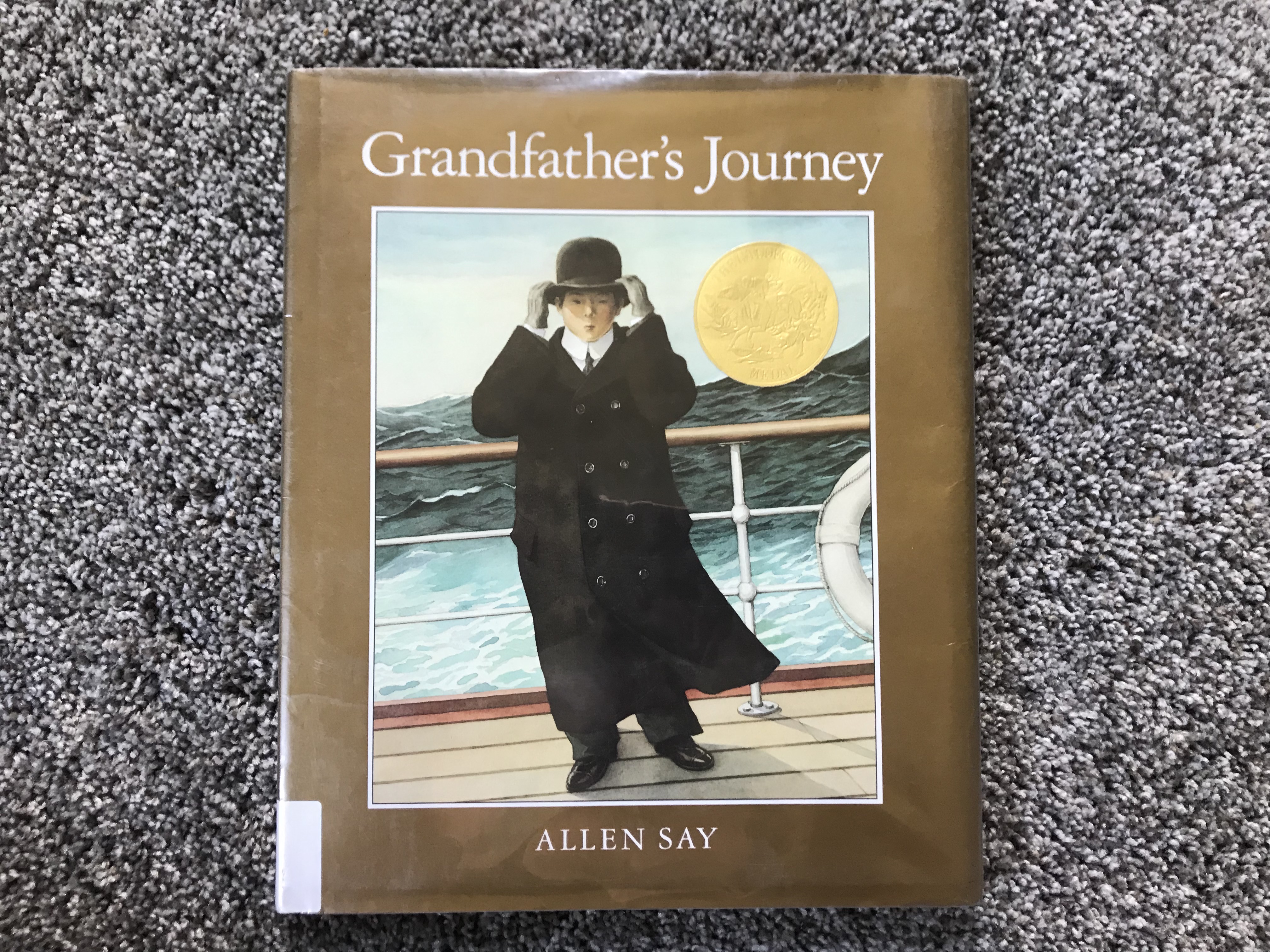
Category: Picture book, nonfiction informational book
Overview of the author/illustrator:
ReadingRockets describes author and illustrator Allen Say: “He dreamed of becoming a cartoonist from the age of six. At age twelve, he was sent off to Tokyo — living on his own — to attend a prestigious school in the city. Instead, he sought out and apprenticed himself to the famous post-war cartoonist, Noro Shinpei, and spent the next four years learning to draw and paint. That experience is described first in his autobiographical novel The Ink-Keeper’s Apprentice (1996) and later in the 2011 picture book Drawing from Memory. At age sixteen, Say emigrated from Japan to California with his father. Allen Say writes and illustrates evocative picture books about family, culture, creative expression, and dreams. Many of his stories movingly express nuanced details about the immigrant experience, something Say and his family experienced first-hand. Say won the Caldecott Medal for Grandfather’s Journey, the story of his father’s own journey from Japan to the U.S. and back again.” (2014).
Brief Summary:
Grandfather’s Journey is a masterfully illustrated picture book that tells the story of Say’s grandfather’s journey to the United States from Japan. He chronicles what it was like for his grandfather to arrive in America, his desperate longing for the place he called home, and his eventual return. Say also describes his own parent’s similar journey, and then eventually, his own. Say speaks of his grandfather’s homesickness for America and Japan – depending on which country he is currently living in, and his own feelings of homesickness: a feeling he knows his grandfather would understand all too well.
Connections:
It comes as no surprise that Grandfather’s Journey is a Caldecott Medal winning book. The illustrations in the book bring to life the feelings and emotions described on each page and give the reader the experience of both countries and what it would have been like to experience both.
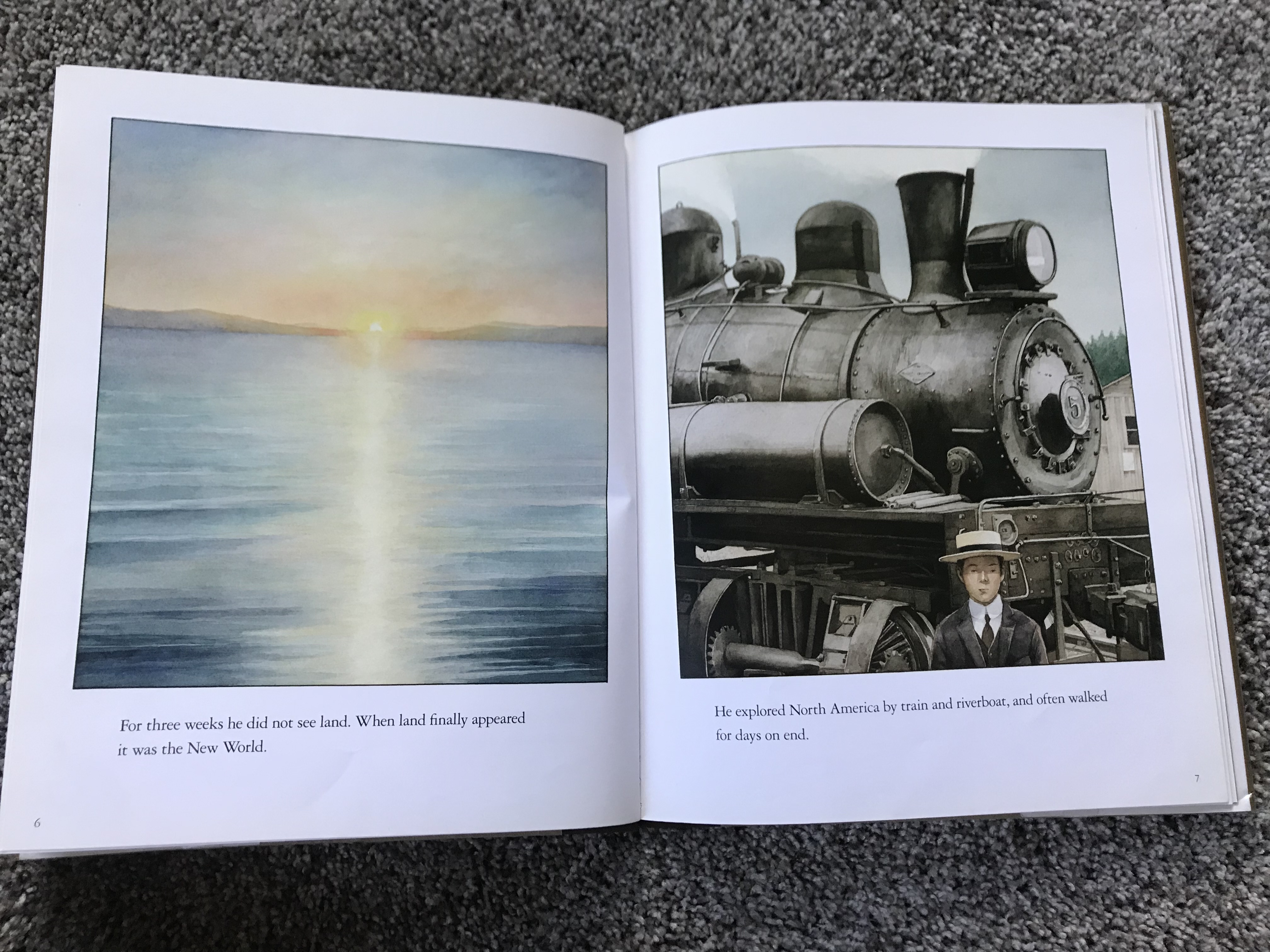
The colors used in the book are outstanding, and bring each page to life. The muted colors in his grandfather’s portrait at the opening of the book make the picture really feel like a portrait of the times, and the depictions of sunsets, deserts, fields, mountains, and coasts in both America and Japan highlight the beauty of both settings and the contrasts between the two. On most pages, Say uses chroma to show stark differences between the settings he has so carefully constructed. For example, pg. 6 shows a beautiful sunset over the ocean with hues of blue and orange, which are shown opposite pg. 7 which depicts a train station, colored in shades of varying black and grey.
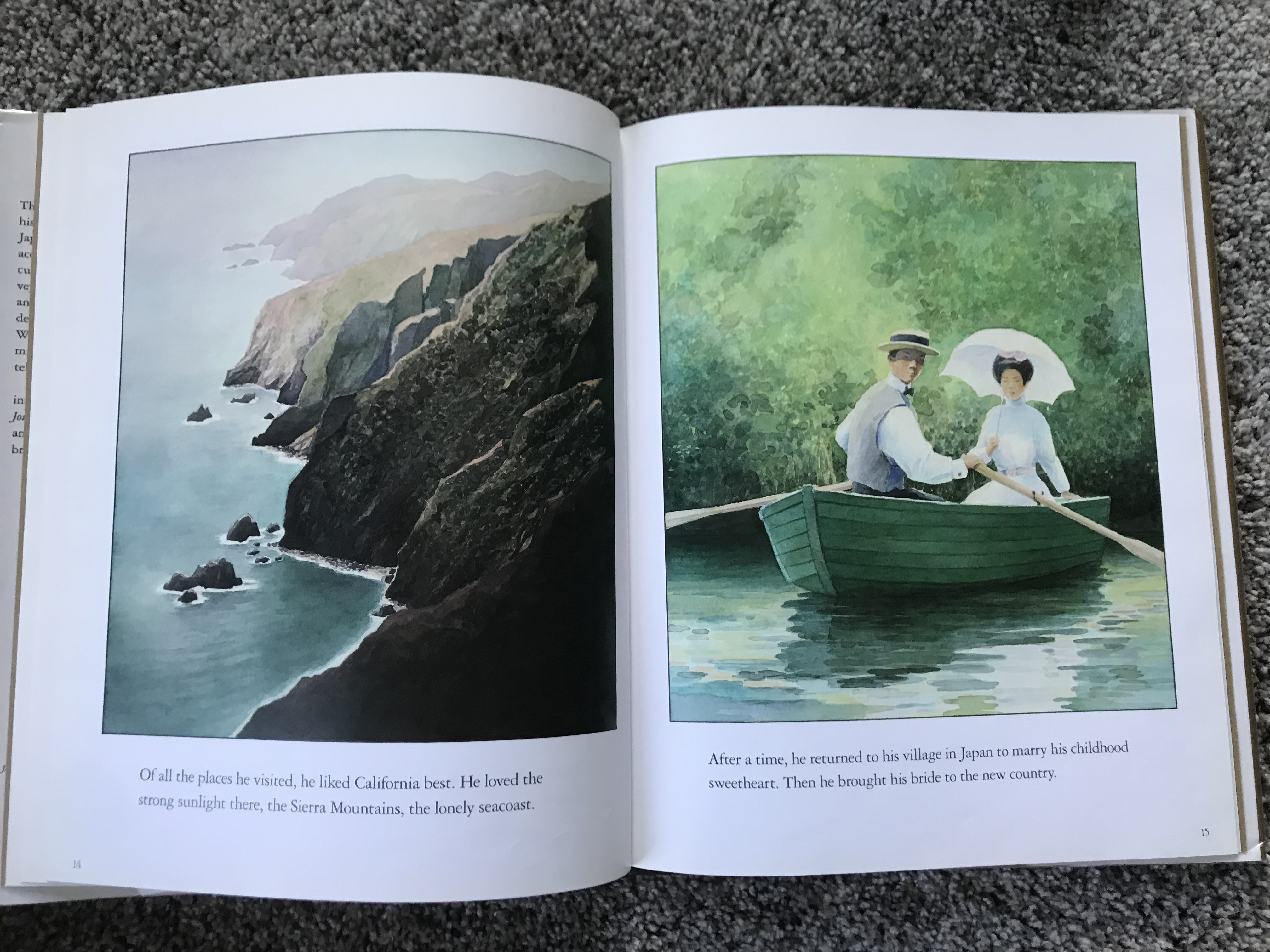
Similarly, pg. 14 features a breath-taking illustration of the California coastline and the Sierra Mountains, using only shades of dark blue, black, and white to depict the loneliness of the coast. This illustration sits next to a portrayal of his native village in Japan: a striking rendition colored in different hues of bright green. Both are beautiful in their own ways, and the author is able to make the reader feel the nearly overwhelming feeling of loving and feeling homesick for both.
Say uses composition to draw the reader’s eye to the part of the illustration that is more important in the scene, and this varies between characters and settings. In the illustrations where the characters are most important, the background scenes are muted: for example, when his grandfather stands in a field in America thinking about his homeland of Japan on pg. 9, the colors in the background are only shades of brown and a very simplistic blue and white sky (think back to the difference in the sky in the sunset illustration – where the setting is the most important aspect).
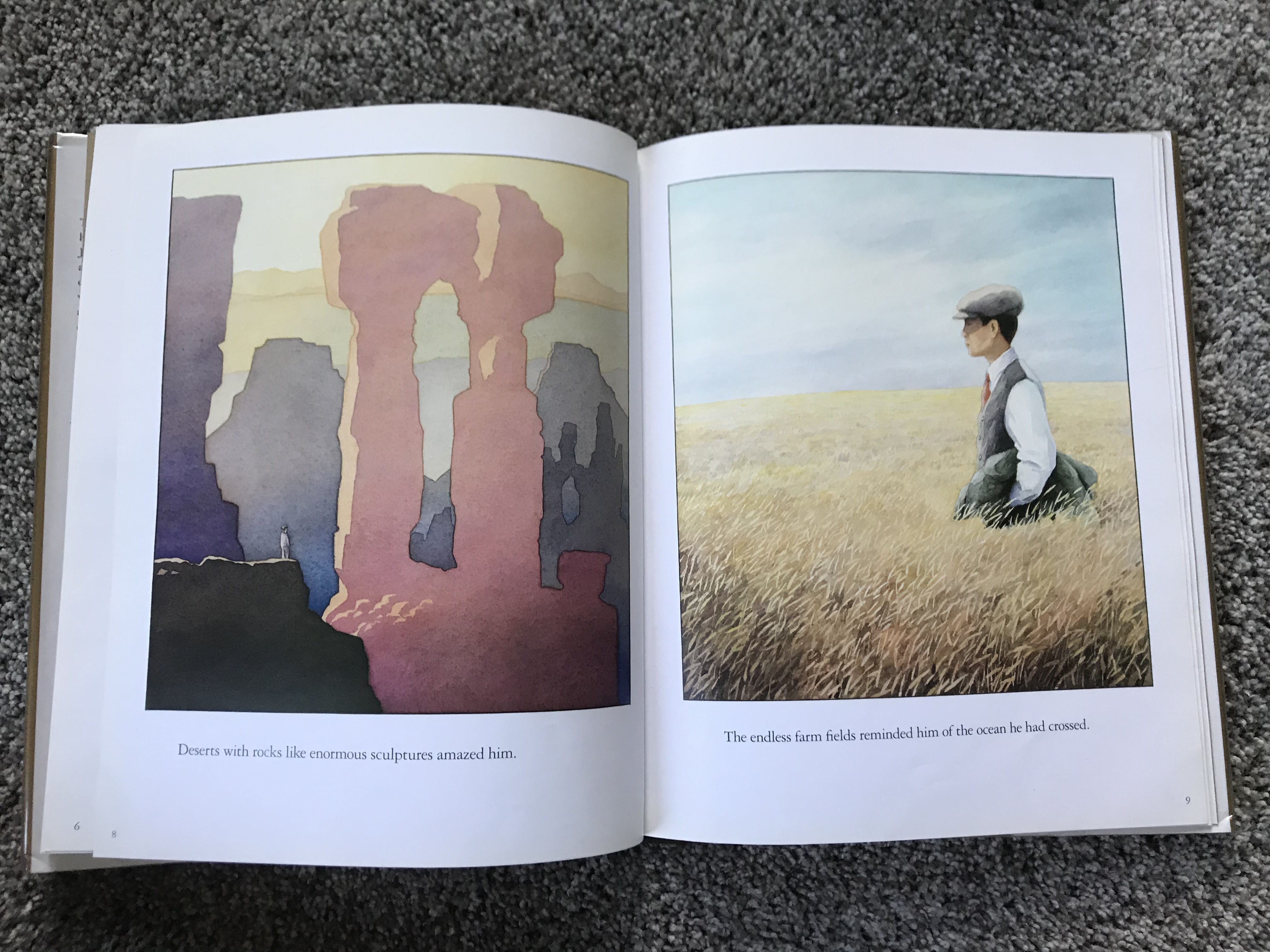
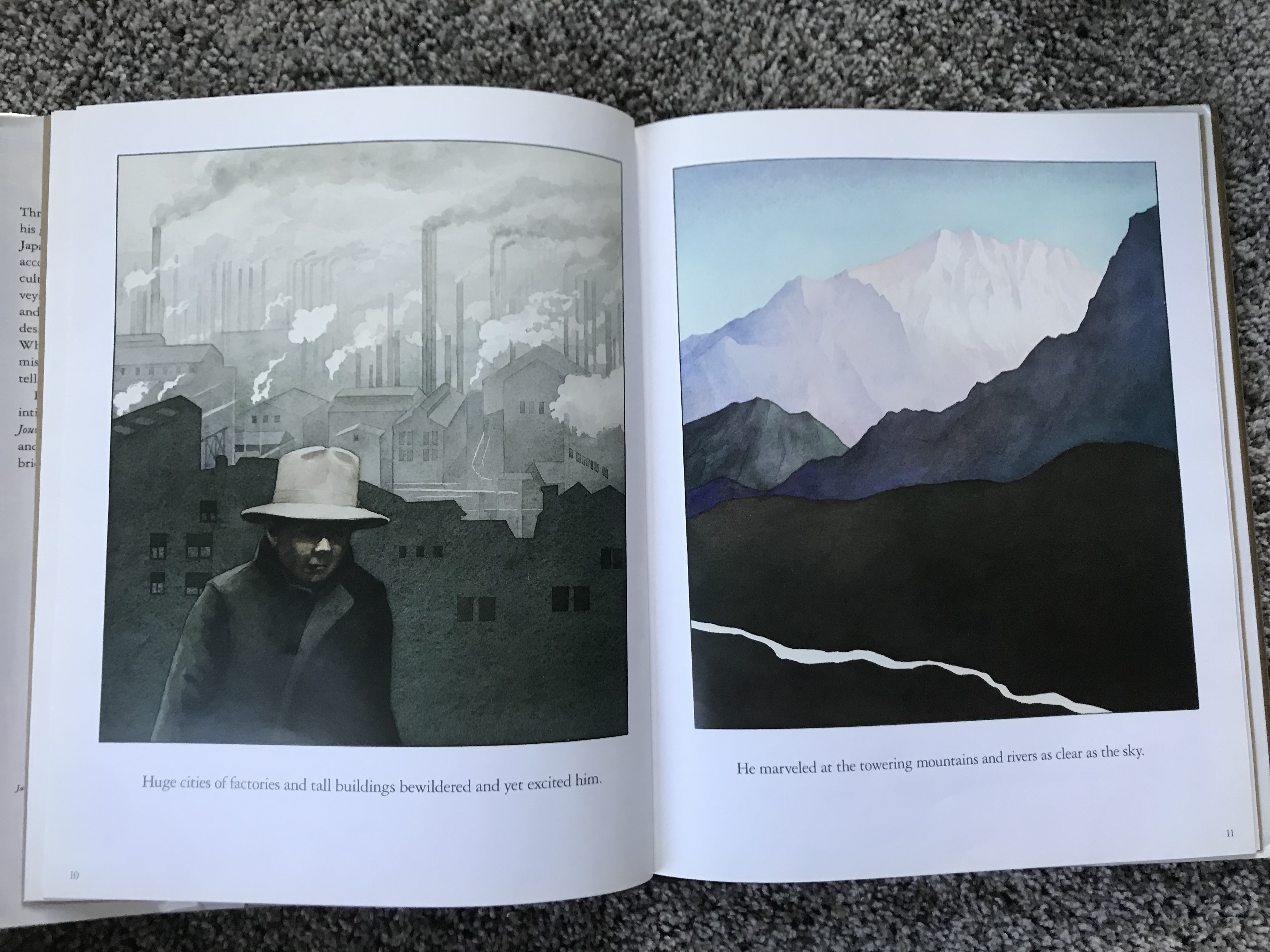
In illustrations where the setting is the most important aspect, the reader’s eyes are immediately drawn to the background and the characters are muted. Take for example on pg. 10, an illustration of “huge cities of factories and tall buildings” (Say, 1993) where the factories are colored in hues of grey and white, in contrast to the character shown who’s face is shielded by his hat and who is colored in very dark hues of grey and black.
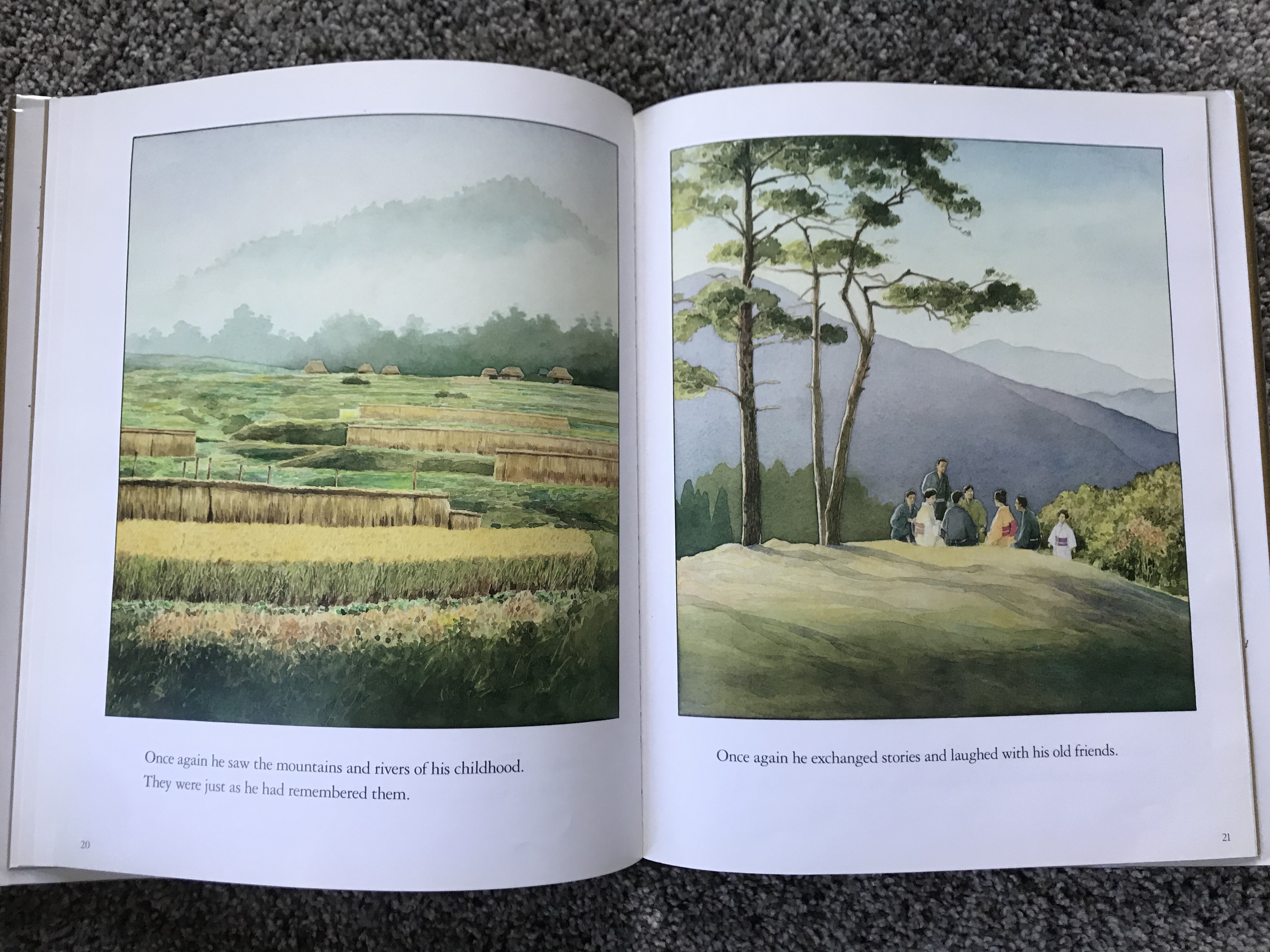
On pg. 21 where the author wants us to notice both the scenery and the characters, the background has much more color than on previous pages – the characters are shown in traditional Japanese dress with many different colors that make the reader notice them right away, but the towering mountains and multicolored trees draw the reader’s attention as well. These noticeable differences show extreme attention to detail by the author, and make the reader unconsciously notice exactly what the illustrator has intended they notice.
The author’s personal style is evident throughout the whole book. Say uses watercolors throughout to depict both America and Japan, and the use of watercolors reminds the reader of traditional Japanese Gansai watercolor art. This makes sense when knowing that Say learned to illustrate under apprenticeships in Tokyo. Tunnel, et. al (2016) explain that “Surrealism is reality skewed. It represents the workings of the unconscious mind by creating a dreamlike state. ‘Surreal, eye-catching imagery can make even the most jaded picture book viewers take notice’ (Gershowitz, 2013).” (pg. 40). This is especially noticeable in Grandfather’s Journey where the illustrations are realistic enough to resemble both America and Japan, but also surreal enough to take us on a ride through the author’s imagination, adding elements of his apprenticeships and upbringing at the same time.
Conclusion:
Tunnel, et al. describe the function of illustration in books as: “‘The function of art is to clarify, intensify, or otherwise enlarge our experience of life’ (Canaday, 1980). This statement is as true for picture book illustrations as it is for gallery paintings,” (2016, pg. 37). This is especially true and seen in Grandfather’s Journey as the illustrations give depth to the story and reinforce the overall emotion present in the story. If Say were to just write about his grandfather and his feelings of homesickness for their two homelands, would we understand the depth of those emotions as well if not for the gorgeous depictions of both places? Likely not – which is why in this book in particular, they are so important.
This book makes me think of several students I have had in the past who shared two different countries as their homelands. I had a student who was from Puerto Rico who regularly cried about how much he missed his grandmother and how much he longed to still live in a place where people spoke his native language of Spanish. I had a student who was from Vietnam, who doodled pictures of snowmen on his papers and explained that it didn’t snow where he was from. I’ve had many students who were from Mexico and often took trips back over breaks and would describe what it was like to stay with their extended families, making tamales over Christmas break and being read to in Spanish.
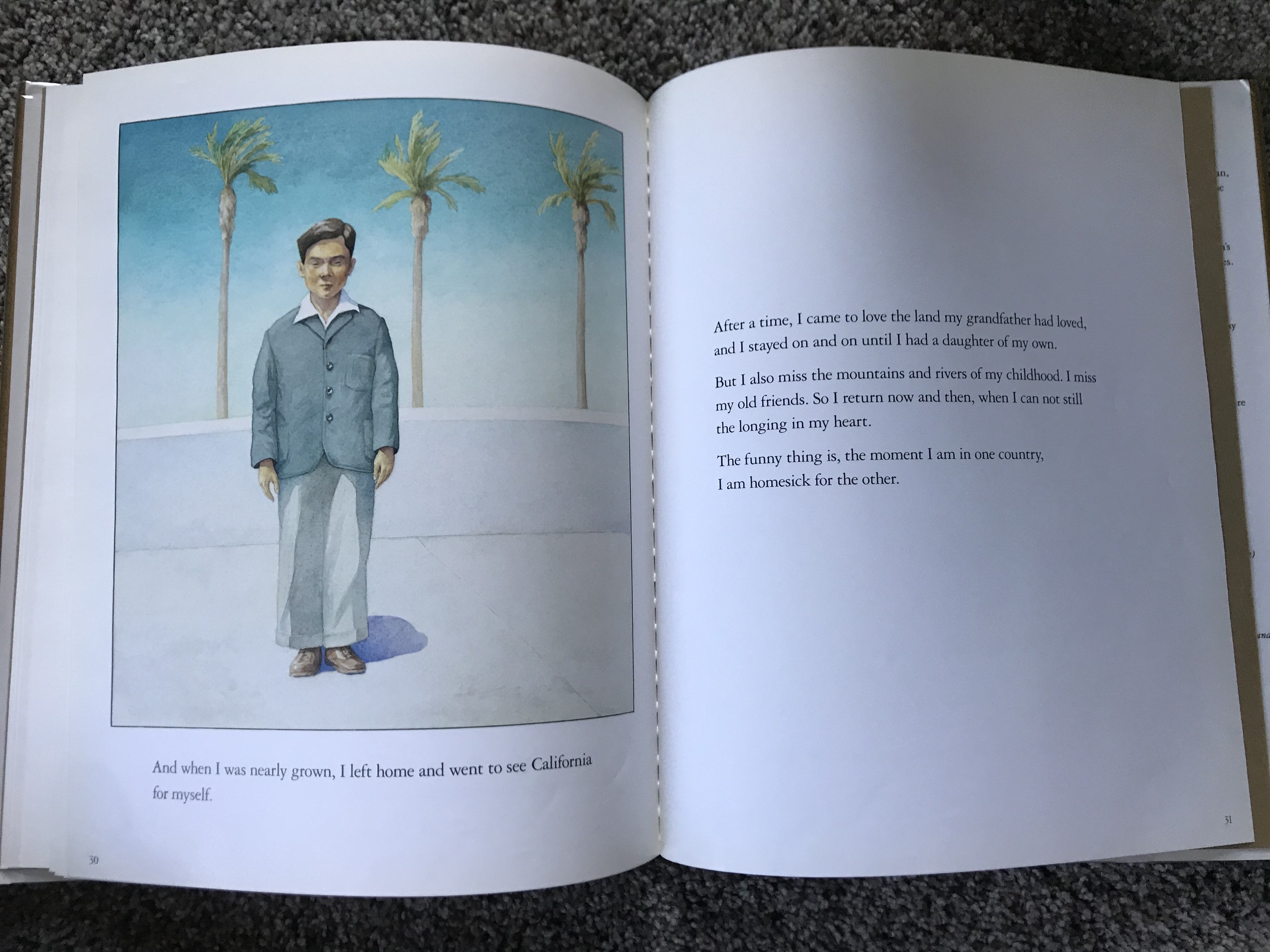
This book reminds us over and over again what it is like to belong to two different places at once, and the feelings that arise from it. This book supports the construction of knowledge because it reminds us, especially in a country where so many of our students come from different backgrounds, that their lived experiences may vary greatly from one another and from ourselves, as teachers. It reminds us to think about where our children have come from, how those experiences affect what they read and think about, the connections that they might have to different stories, and how important it is to honor all of those parts of their selves so that they are not forgotten and so that they feel as comfortable as possible: especially in a new place. Say (1993) speaks of the huge factories that “bewildered and yet excited him,” (pg. 10 and how he “marveled at the towering mountains and rivers as clear as sky” (pg. 11), along with how “the village was not a place for a daughter from San Francisco,” (pg. 22) and most importantly of all, the longing he felt and how he would return to both lands, because “…the moment I am in one country, I am homesick for the other,” (pg.31).
The book serves to validate all of those emotions, to remind them that it is okay to miss the place they are from while still loving and appreciating where they are now. All of our students have different experiences worth sharing and worth being listened to, and this book is one that can help to remind that fact to readers young and old.
References:
A video interview with Allen Say. (2014, August 26). Retrieved June 13, 2019, from http://www.readingrockets.org/books/interviews/say
Say, A. (1993). Grandfather’s Journey. New York, NY: Houghton Mifflin Company.
Tunnell, M. O., Jacobs, J. S., Young, T. A., & Bryan, G. (2016). Children’s Literature, Briefly (6th ed.). Upple Saddle River, NJ: Pearson.
 Adventures in Children's Literature