
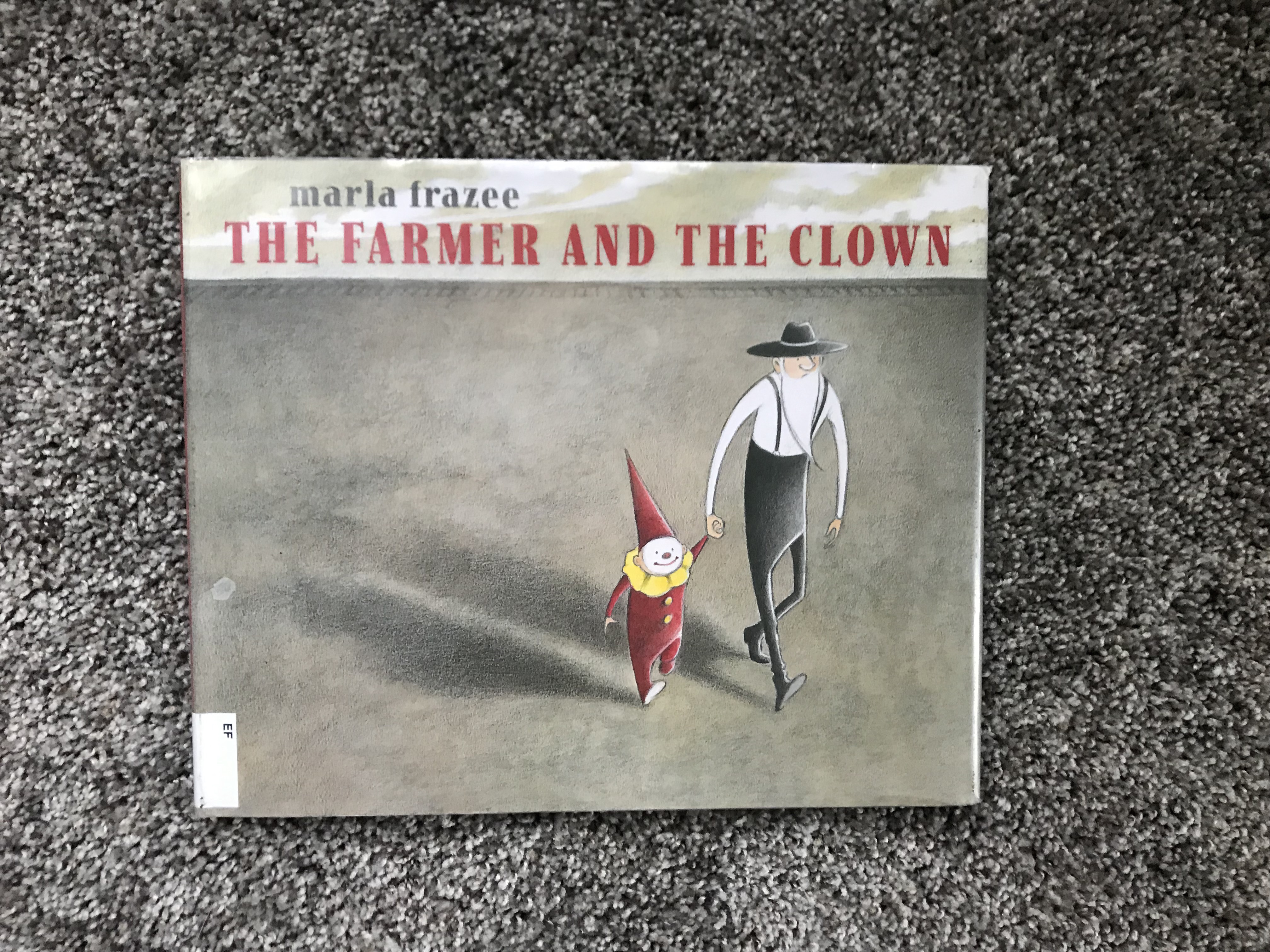
Book: The Farmer and the Clown written and illustrated by Marla Frazee, published by Beach Lane Books, Boston Globe Horn Book Award winner for Picture Book.
Category: Picture book, realistic fiction, concept book
Overview of the author/illustrator:
According to her own bio, Marla writes books about “Babies, birthday cake, boxer shorts, boys, roller coasters, Santa Claus. I tackle serious topics on a regular basis.” Marla always says that to be a children’s book writer and illustrator, you must: “Study the genre and the best books of the past. Check out what is being published today. Read all the time. Read everything you can. Be passionate and honest about what you are doing and why you are doing it. Love it. Tell stories that matter to you.” Marla believes in the importance of supporting independent bookstores and protecting literary culture, and she writes from her own studio under an avocado tree in Los Angeles, California. (Frazee, 2019).
Brief Summary:
The Farmer and the Clown is a stunning visual treat; a book with no words, where the carefully constructed illustrations take the lead on a concept we all know but often forget: two people of very different backgrounds can find common ground. A small clown child falls off a train and befriends an old farmer, and in a few short pages we are reminded of what we can learn from others if we just give them a chance to show us.
Connections:
This beautiful book is entirely wordless, but the drawings are able to capture what words, adequately, likely would not. The author of this book uses many different visual elements to get across the underlying message: others have a lot to teach us.
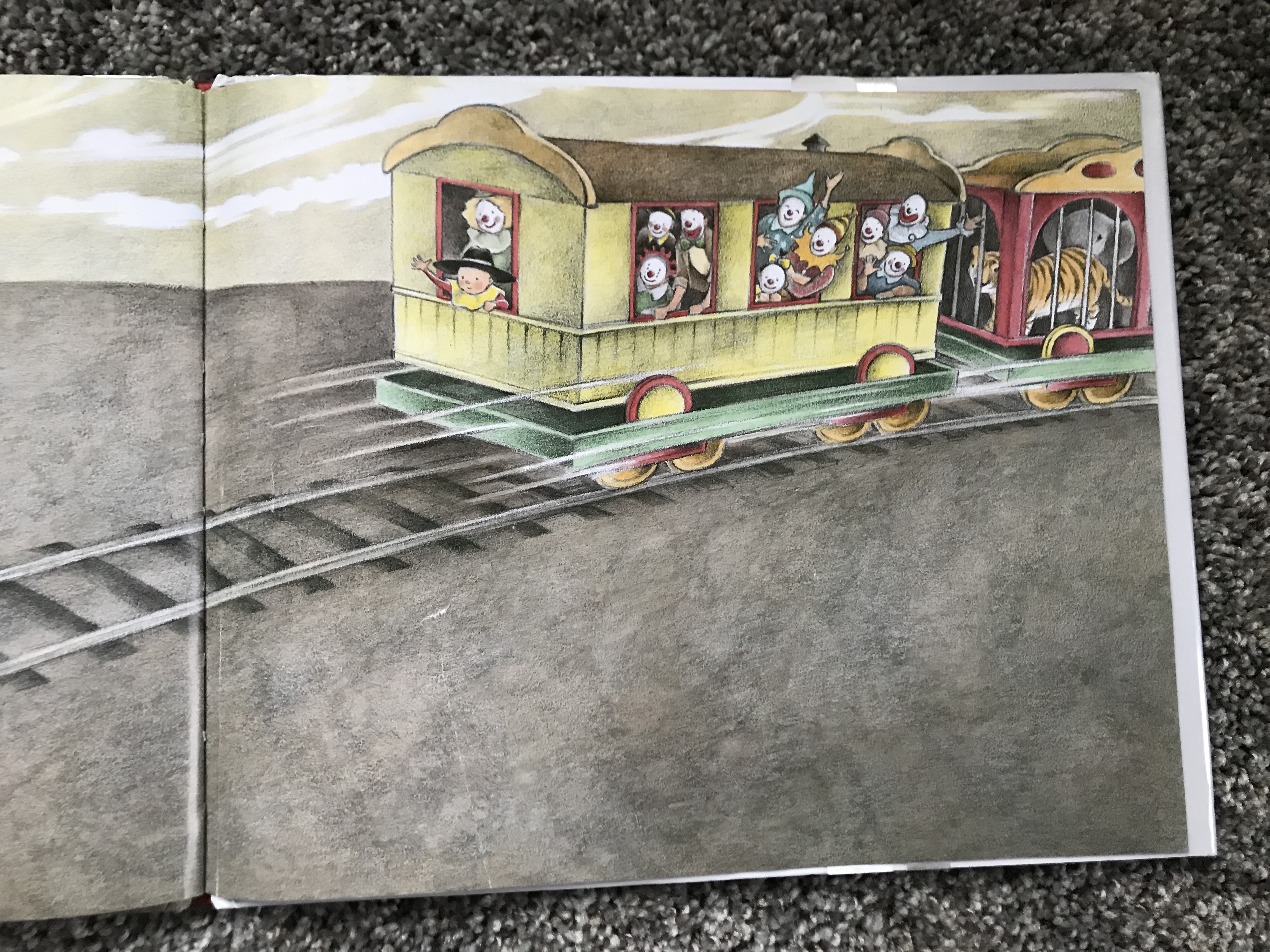
The colors in this book portray the overall mood. A grumpy farmer is positioned in a grey and brown barren field, when a colorful circus train comes by. The colors in the train nearly pop off the page when contrasted by the sullen field, and the child clown’s vibrant yellow and red and whimsical smile are contrasted as well by the farmer’s plain white and black outfit.
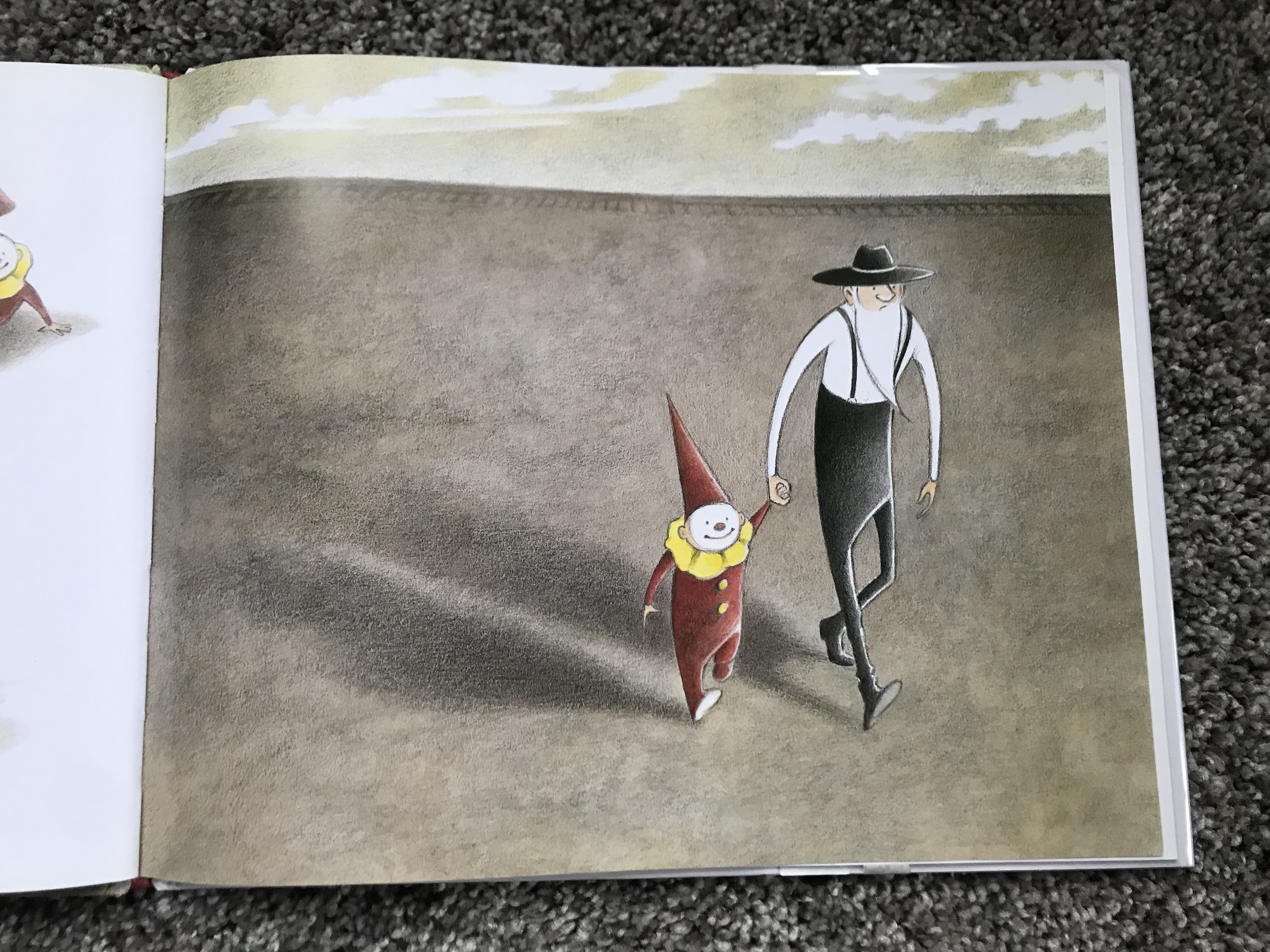
The illustrator is careful to show this calculated attention to detail in all of the scenes: when the child clown is shown inside the farmer’s house, the colors inside are still a muted: varying shades of grey and brown that make the farmer’s change into red (almost matching) pajamas evident. Even the tree in the field is shown as shades of brown instead of green, making the presence of the outsider: the clown, well known. When the circus train arrives again, a full rainbow of color can be seen, perhaps to highlight the intricate differences between the two groups of people – lone farmer and clowns.
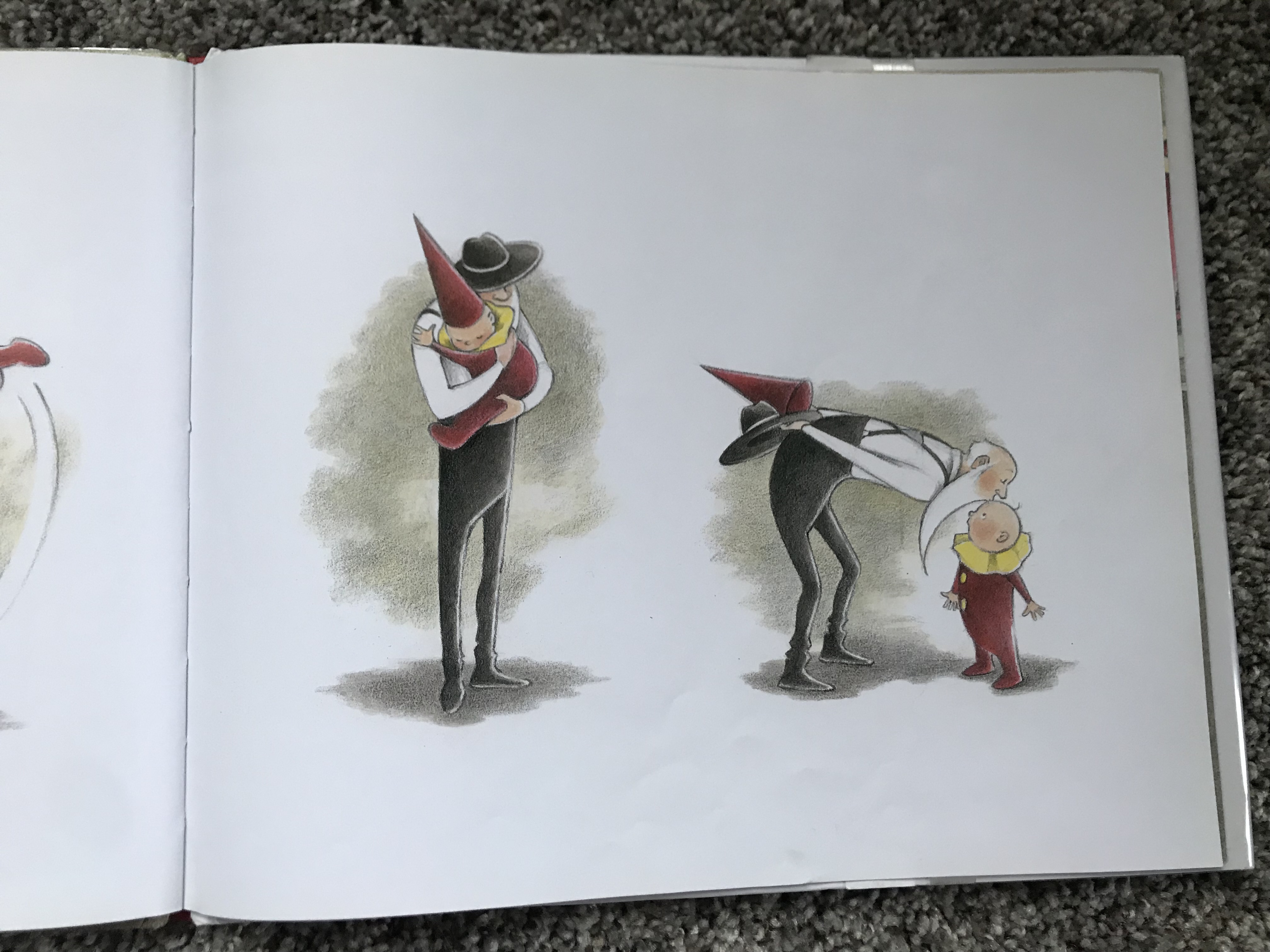
The use of line is purposeful as well; the softness of the lines makes a book that lacks bright colors approachable to the children who will see it, and the use of simple lines show facial expression: from the farmer’s scowl on the very first page to the child clown’s nearly omnipresent smile, gasps of laughter, and the sheer joy on the child clown’s family’s faces when they see him again.
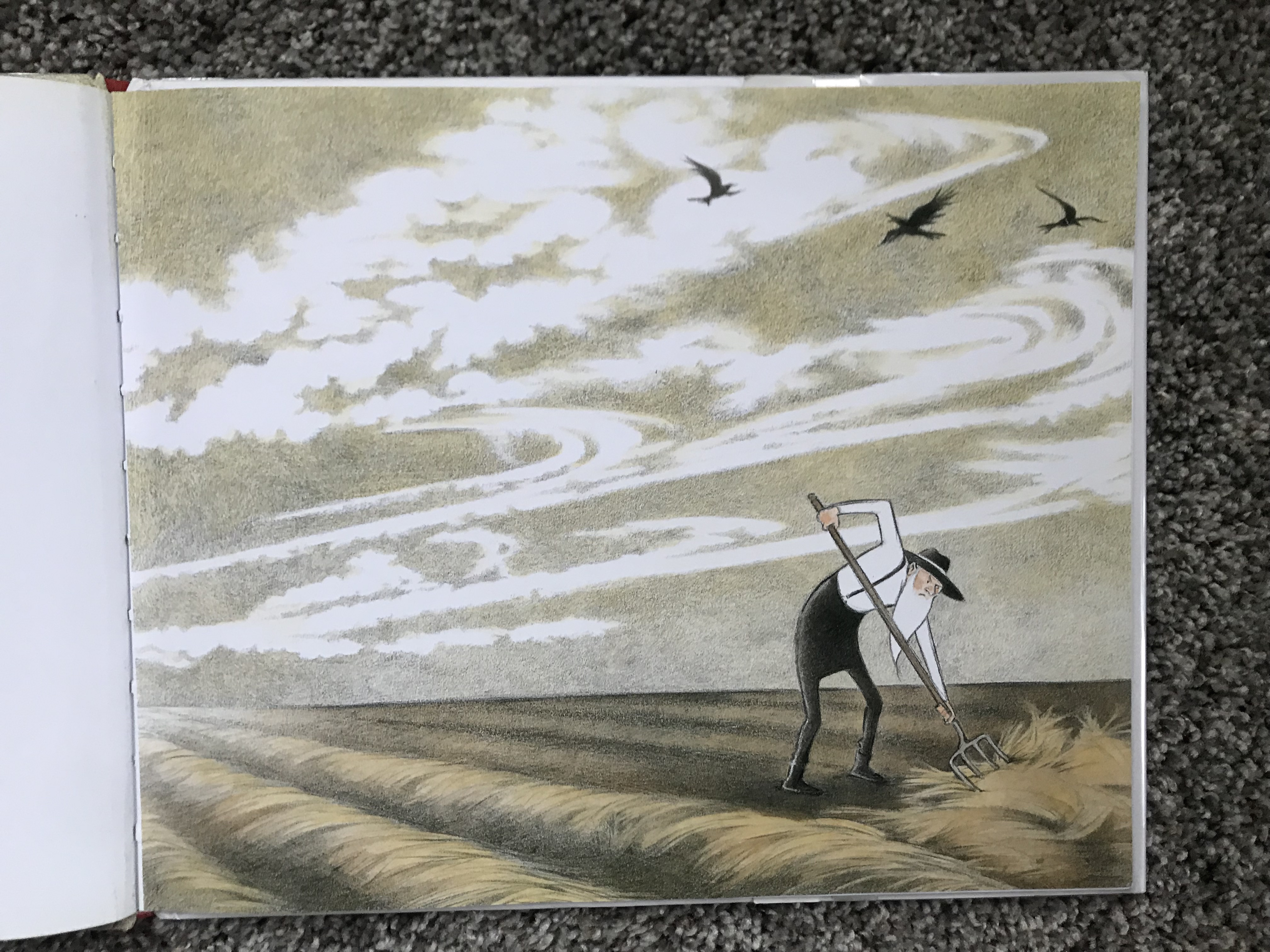
Line is also used to show excitement, when the child clown points to where he came from, when he sees the train appearing in the distance, and again around his family when they return. The lines in this book fill in the spaces where words, deliberately, are not present.
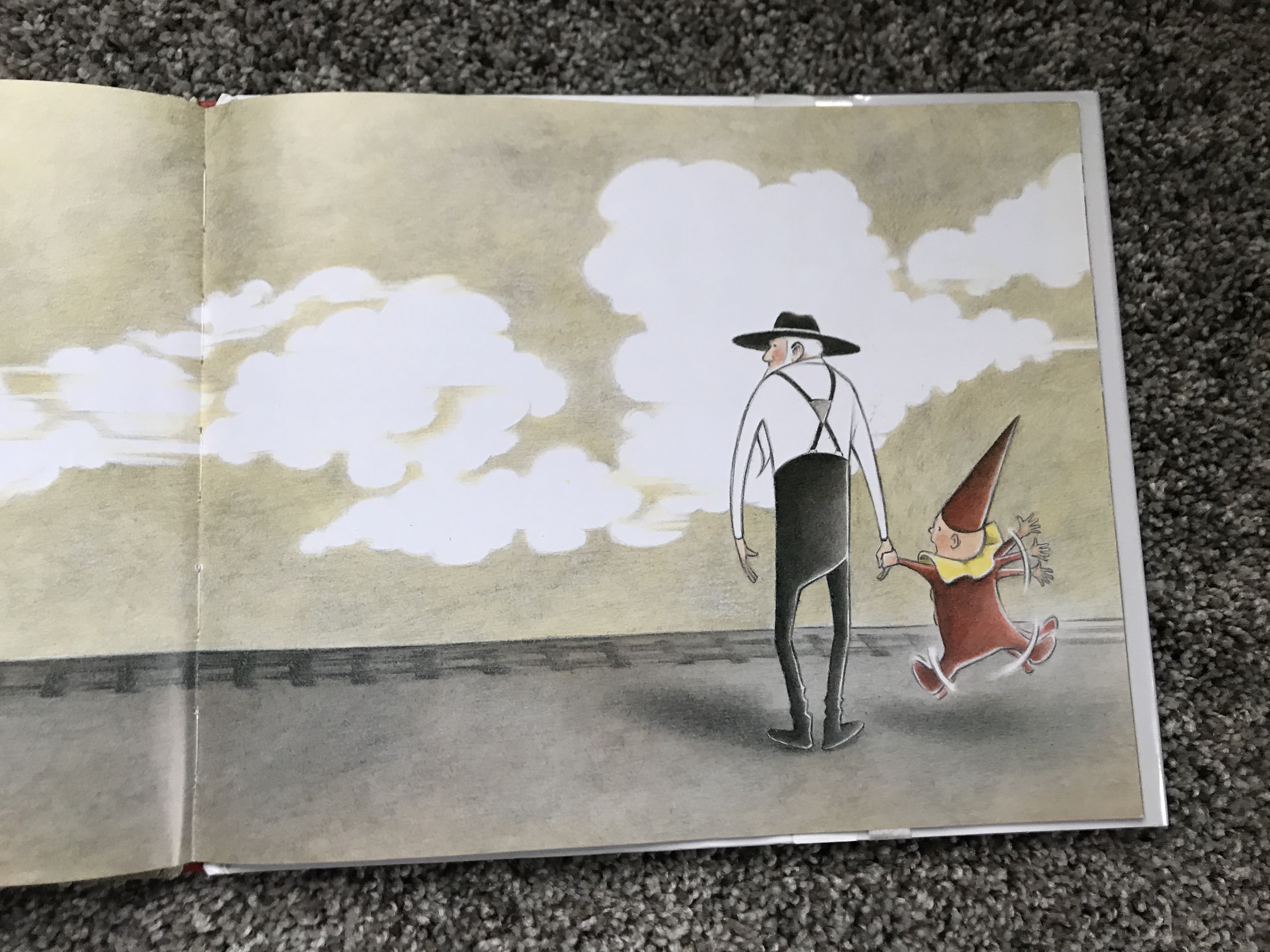
The illustrations in this story depict action where words are devoid: “Sometimes action in illustrations is subtle but suggests a great deal of activity,” (Tunnell, et al, 2016, p. 43). The small actions of a small child reaching up to hug an adult’s leg, a man putting on and taking off his hat to make an uncomfortable child smile, the sigh of a long day’s work, and the shared bond that comes with a picnic in the grass afterward.
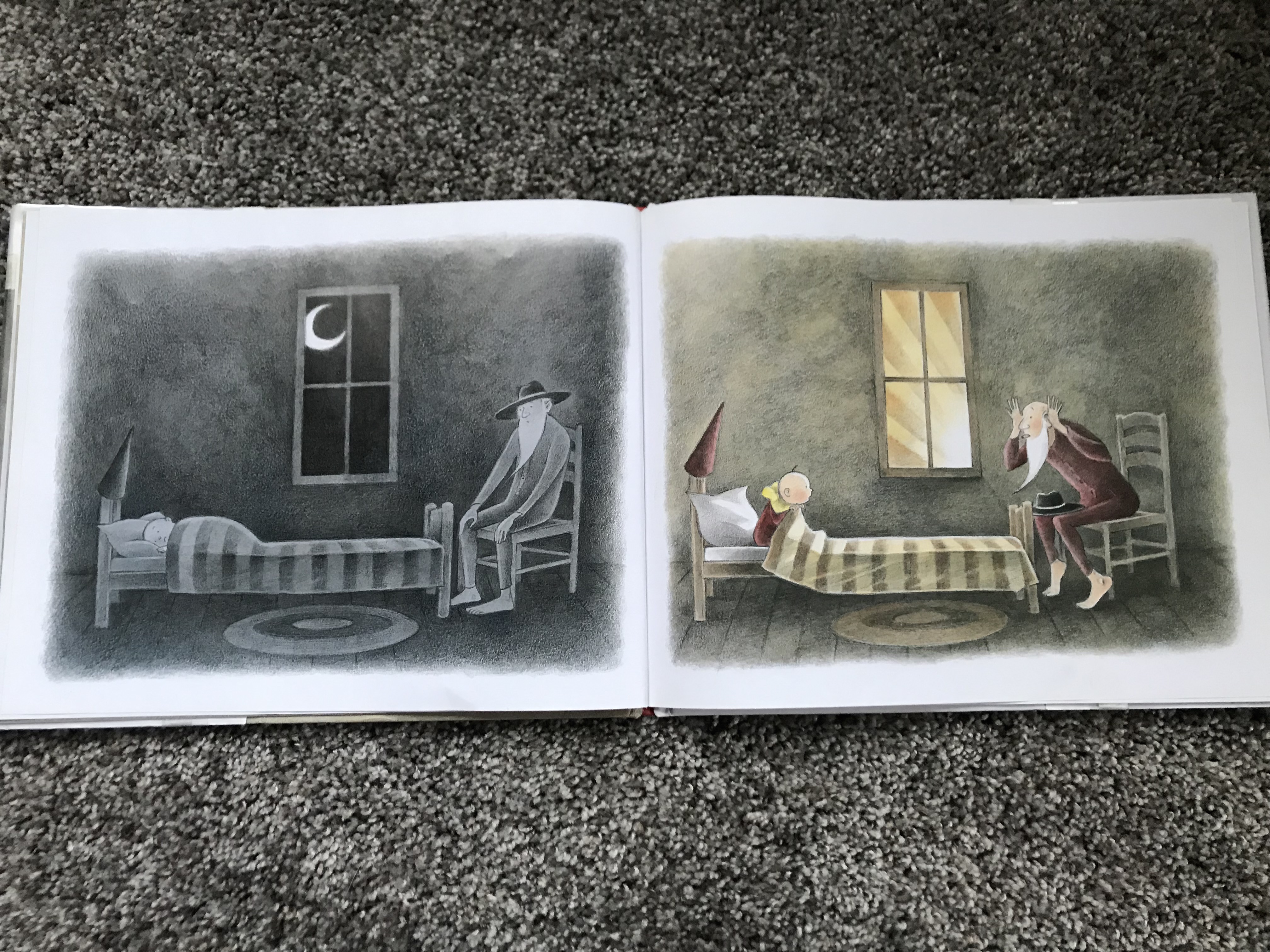
Although the drawings in the book are simple, they do not lack depth. You can feel the boy’s embarrassment when he gets his clothes wet, his fear of the night in a new strange place, his joy at showing what he knows, his excitement to see his family again, and the loss of his newfound friendship when it is time for him to go. The illustrator is able to show all of this, without a range of color, shapes, textures or filled in backgrounds.
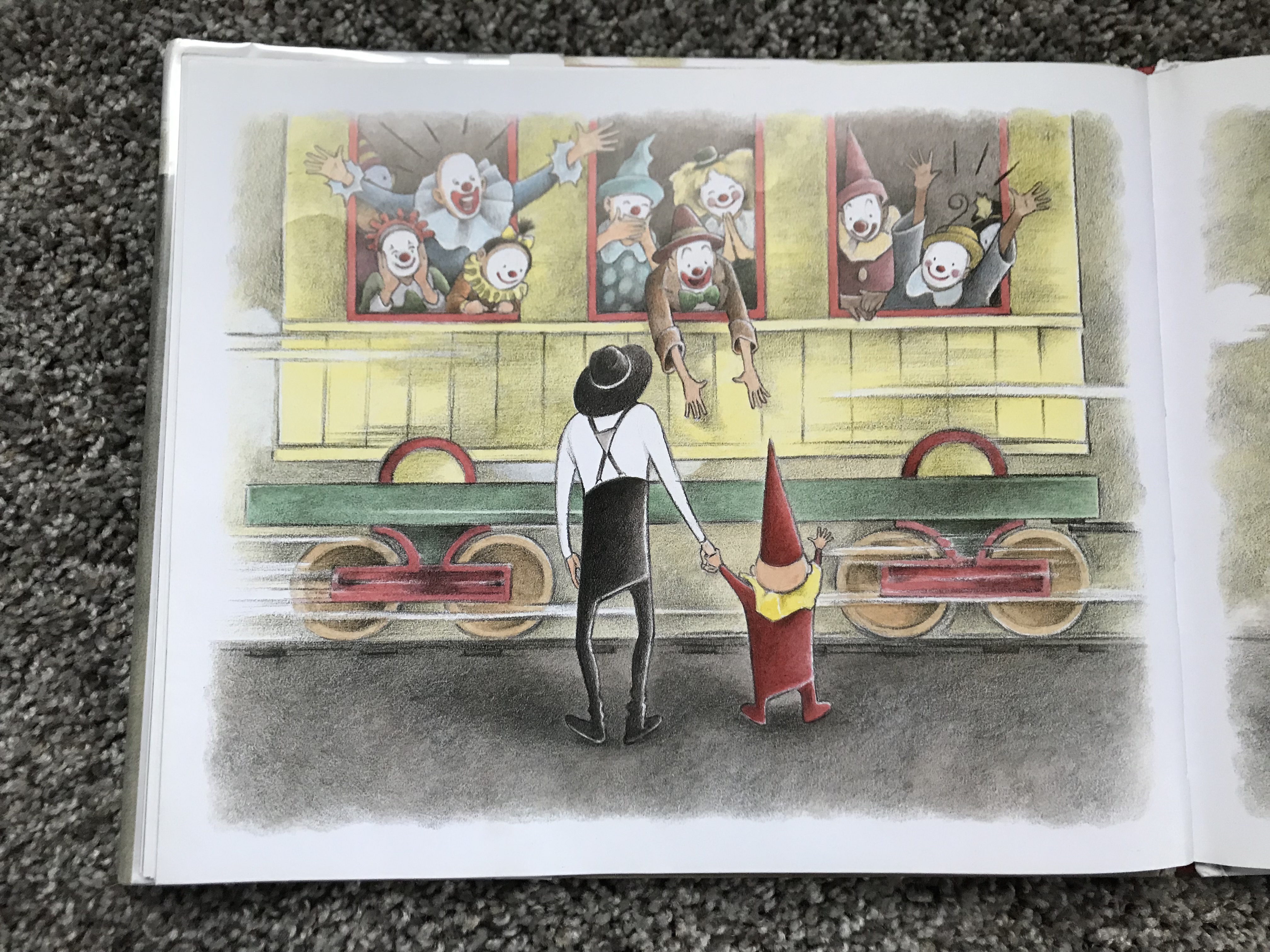
Everything in this book is intentional: from the matching red pajamas on the farmer and the clown child to the matching red end papers of the book. The simple illustrations convey the simplest message of all: two people who are vastly different can share a lot, learn from each other, and learn to love and care for each other, if they’re willing to give one another the chance.
Conclusion:
This book supports construction of knowledge in a very basic way. A small child, who has no preconceived notions of what differences they may have, loses his family and finds an adult that he trusts will take care of him. He shows him what he knows (how to juggle) and the farmer shows him what he knows (how to milk a cow, rake the field), and they bond just by being humans: sharing meals, laughing, working together, and having a picnic. The farmer sees a child who needs love and a home and provides it – regardless of how the boy might be unlike him. He assumes that he can learn and help, and he does. Active learning theory asserts that children learn by being active in their roles, not just by being told what to do. The boy works alongside the farmer, being shown what to do, immersed in the work to be done. Had the characters been two grown adults, from rival backgrounds, would the story have been the same? Two people just helping each other and connecting in the most fundamental ways? Maybe not: and that is the beauty of this story.
References:
Frazee, M. (2010-2019). Retrieved June 11, 2019, from http://marlafrazee.com/about
Frazee, M. (2014). The Farmer and the Clown. New York: Beach Lane Books.
Tunnell, M. O., Jacobs, J. S., Young, T. A., & Bryan, G. (2016). Children’s Literature, Briefly (6th ed.). Upple Saddle River, NJ: Pearson.
 Adventures in Children's Literature