
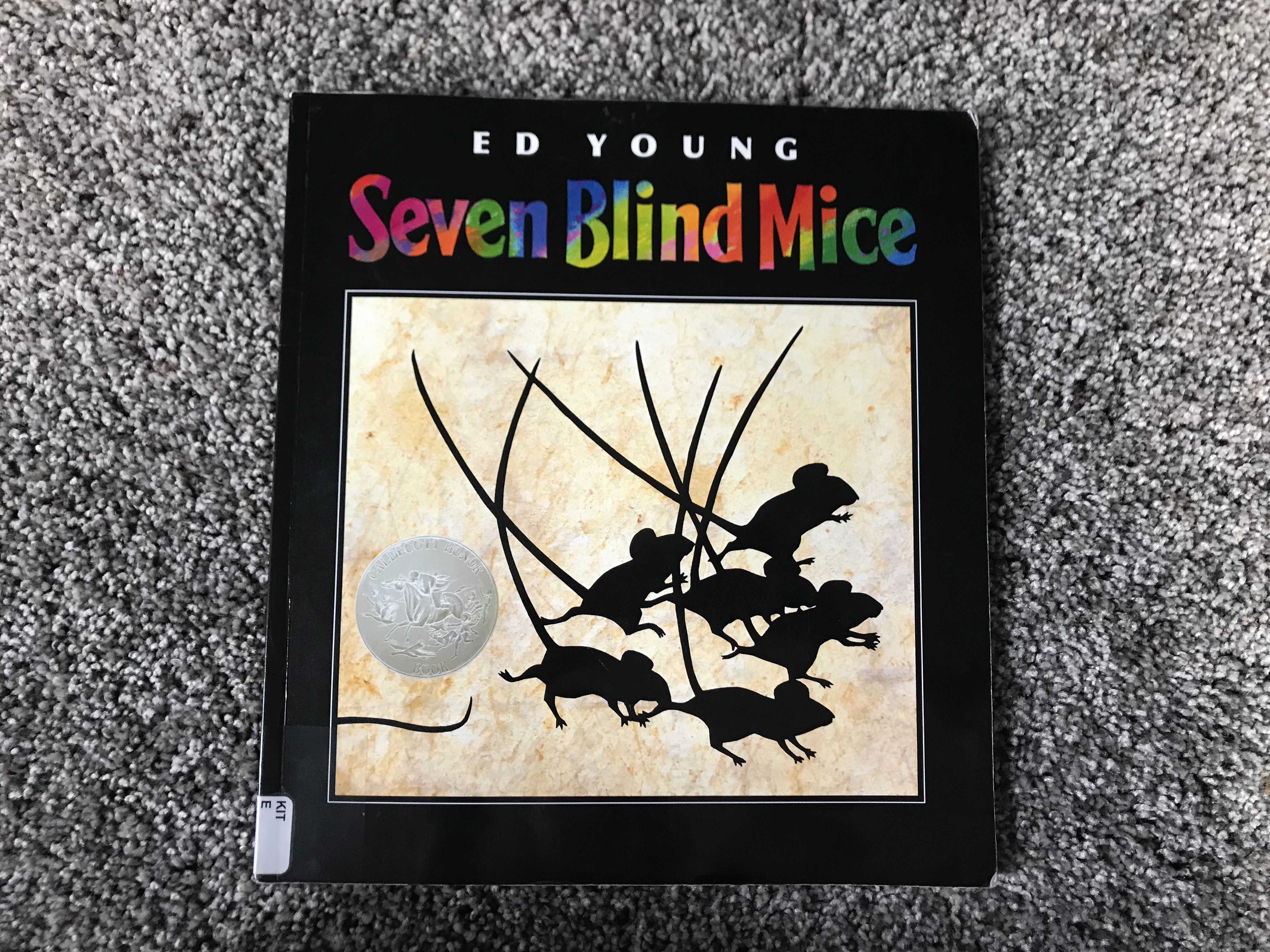
Book: Seven Blind Mice written and illustrated by Ed Young, published by Puffin Books, a Caldecott Honor Book.
Category: Picture book, concept book, fantastic fiction.
Overview of the author/illustrator: From his very own website, Ed Young describes himself as follows:
“Caldecott Medalist Ed Young is the illustrator of over eighty books for children, seventeen of which he has also written. He finds inspiration for his work in the philosophy of Chinese painting. “A Chinese painting is often accompanied by words,” explains Young. “They are complementary. There are things that words do that pictures never can, and likewise, there are images that words can never describe.
According to Young, a strong foundation of credibility must be established in order to create new and exciting images. Through such images, he hopes to capture his readers and ultimately expand their awareness. Young’s quest for challenge and growth are central in his role as illustrator.” (Young, E. 2006).
Brief Summary: This beautifully illustrated children’s book is about a group of blind mice, who attempt to figure out what the object that appeared before them is. The mice go touch it one at a time, drawing conclusions as to what the object must be, only knowing a very small portion of what really lies in front of them. The final mouse runs all along it, and puts all of the pieces together to figure out what the object truly is.
Connections: Although this book does include numbers, and would be wonderful to use with children learning number words as the numbers: first, second, third, fourth, fifth, sixth and seventh all appear in the book, I do not believe this to be a counting book. Rather, this book is a concept book. Children’s Literature Briefly (Tunnell, et al, 2016) defines a concept book to be one that will “…introduce single, focused concepts to young children…. quality concept books tend to help children think about ideas…” (p. 72).
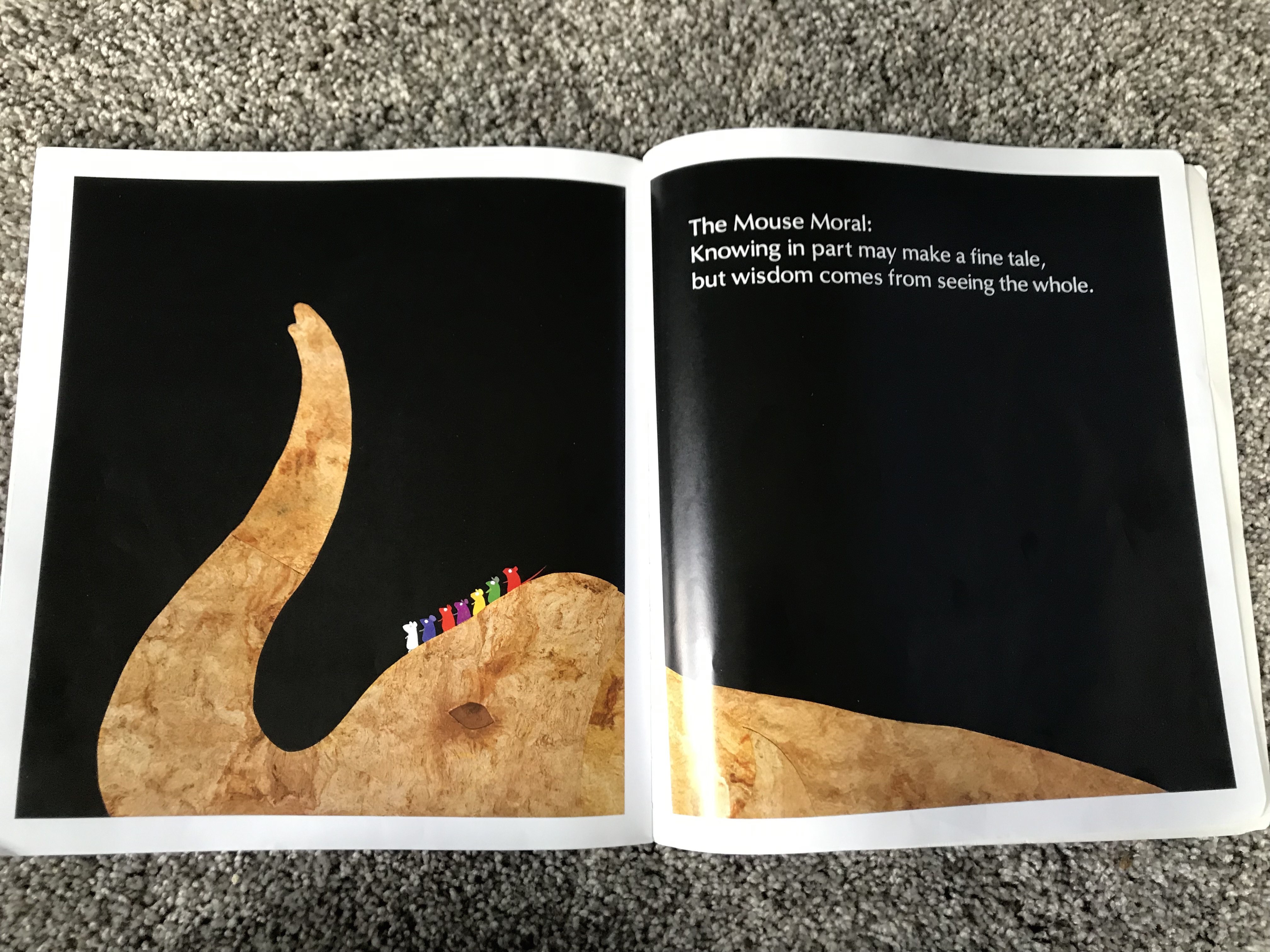
Seven Blind Mice is a book that includes gorgeous illustrations and number words, but what it really does is introduce the concept of making assumptions when you don’t have a full, clear concept in view. The book also helps to explain how some people might have different opinions about things, based on what they can see, or in this case: feel. Each mouse has a different idea about what the object is because they have different perceptions based on the parts they can feel. This would set the stage for teaching children about opinions, disagreeing respectfully, and understanding different perspectives, backgrounds, and ideas. The book even states a moral: “The Mouse Moral: Knowing in part may make a fine tale, but wisdom comes from seeing the whole.” (Young, 2012).
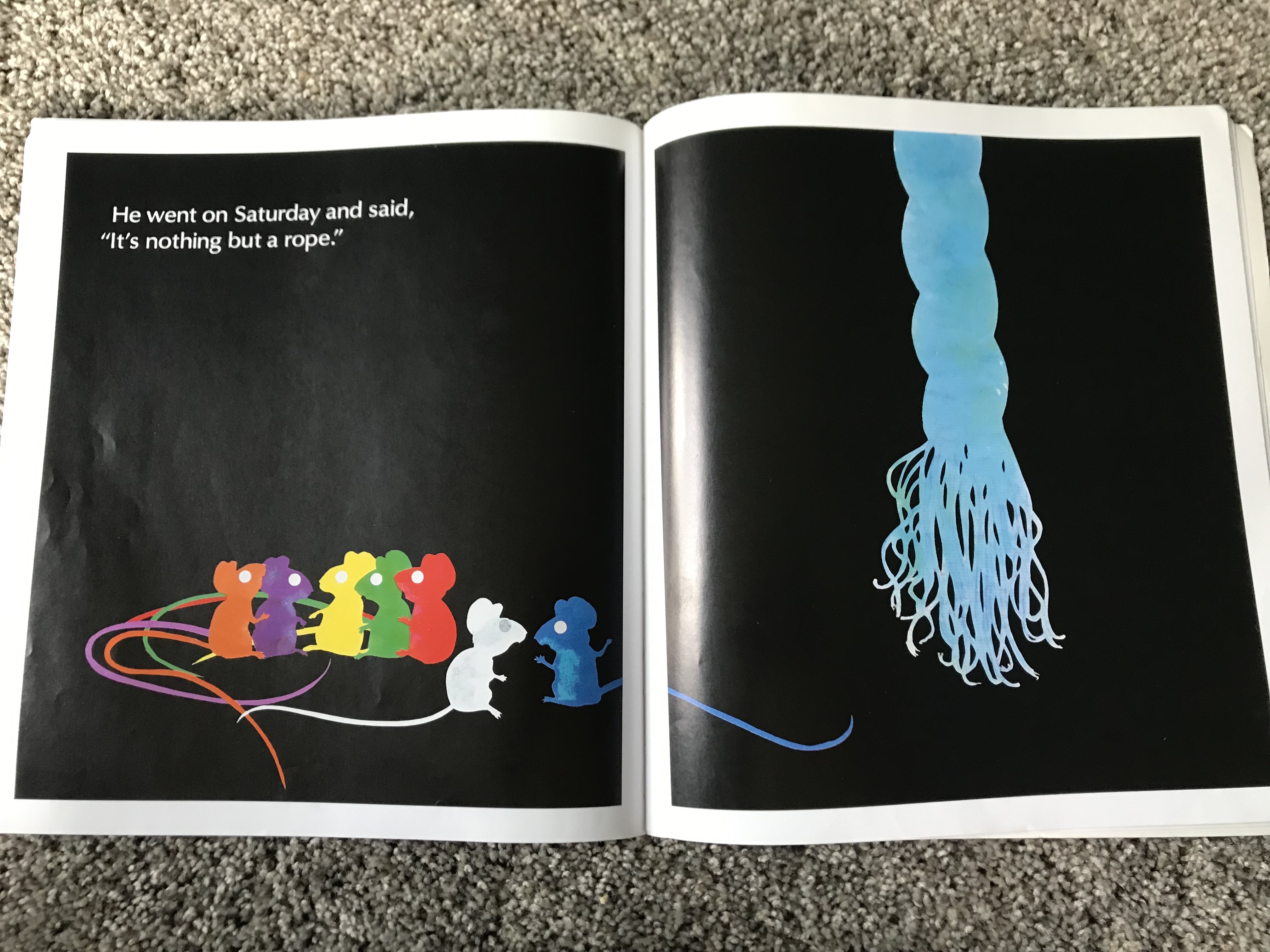
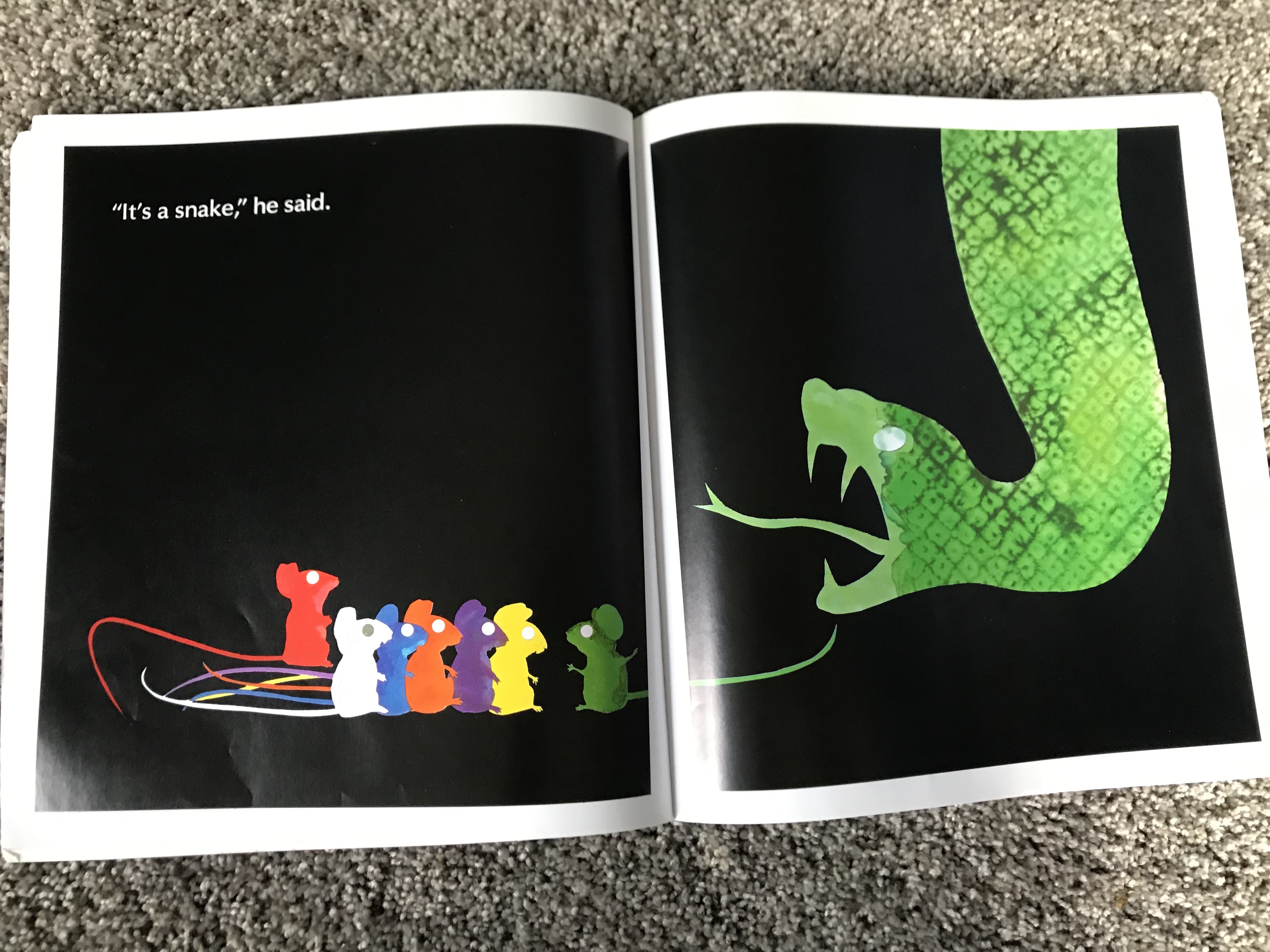
This story connects with constructivist learning, because constructivism is a theory that states that people take their lived experiences and prior background knowledge into account when adding new information. People construct their own ideas based on what they already know. In other words, their prior background knowledge is the foundation for the house that will be built from the new. In Seven Blind Mice, the mice construct their own views on what lies before them based on what they already know. The sixth mouse, having the prior knowledge of what a rope is (we can assume by touching and feeling one before), decides that the object that he has felt is a rope. It is really an elephant’s tail, but since he cannot see it, he builds on his previous knowledge (it’s long, there are strings at the end, it is lumpy like a rope) to determine what it is. The second mouse thinks it is a snake for similar reasons: he has prior knowledge that a snake is long, scaly, often curved – and this is what he determines the elephant’s trunk to be.
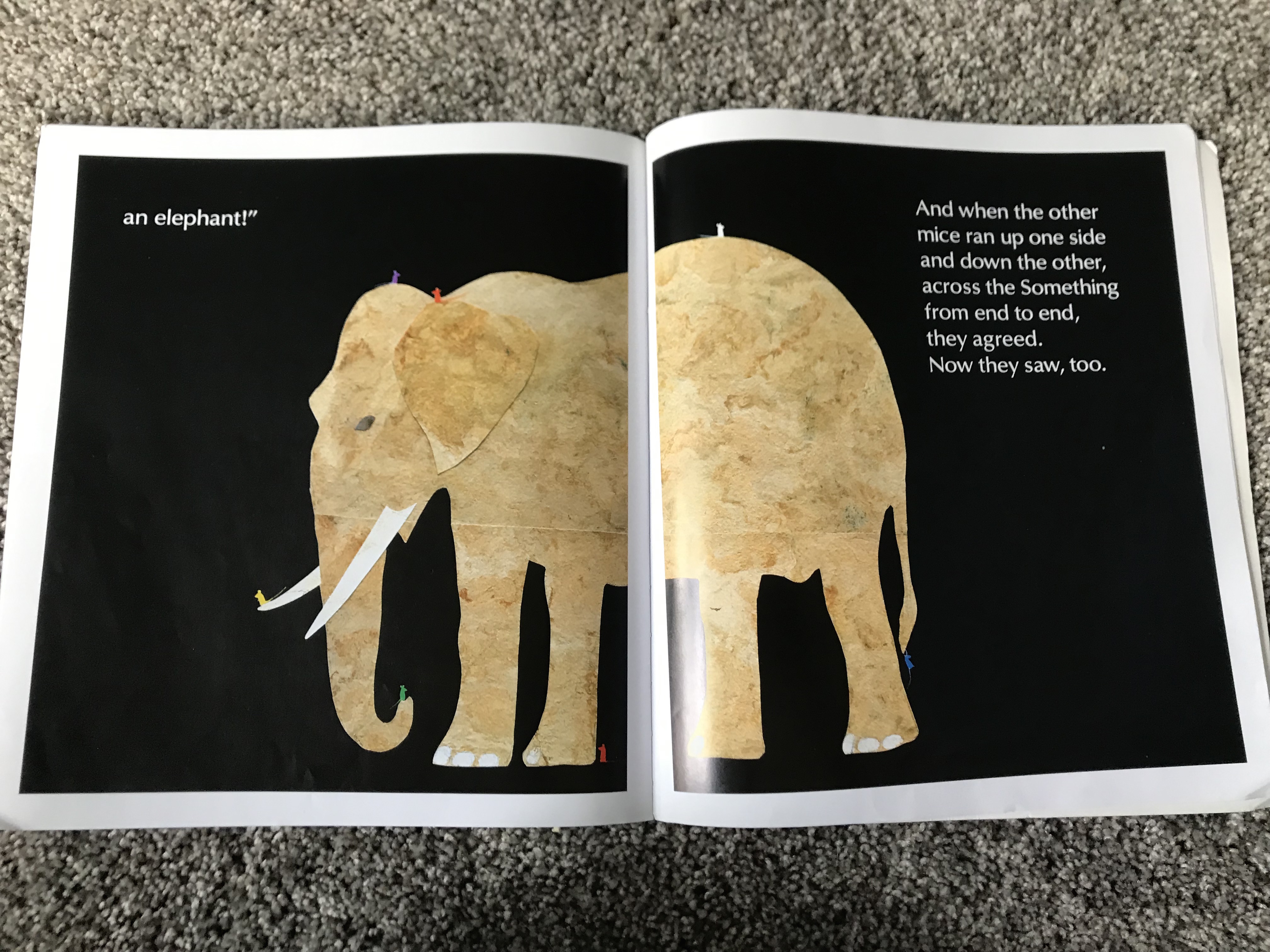
It is only the last mouse, the seventh mouse, who is able to figure out that the object before them is actually an elephant. The seventh mouse doesn’t just rely on one part of the elephant, or one of her previous developed schemas, but rather all of the knowledge she has all placed together to figure it out. “When she came upon the Something, she ran up one side, and she ran down the other. She ran across the top and from end to end. ‘Ah,’ said White Mouse. ‘Now, I see. The Something is as sturdy as a pillar, supple as a snake, wide as a cliff, sharp as a spear, breezy as a fan, stringy as a rope, but altogether the Something is… an elephant!” (Young, 2012). The other mice only see one part each, and use the information they have, connecting it best to what they already know, to make incorrect guesses about what it could be. The white mouse is able to use everything she knows about elephants to put all of the pieces of this puzzle together. If she didn’t know anything about elephants, well, she’d still be left in the dark, imagining a Something that it Very Much Was Not.
References:
Tunnell, M. O., Jacobs, J. S., Young, T. A., & Bryan, G. (2016). Children’s Literature, Briefly (6th ed.). Upple Saddle River, NJ: Pearson.
Young, E. (2006). Retrieved June 11, 2019, from https://edyoungart.com/about.html
Young, E. (2012). Seven blind mice. New York: Puffin Books.
 Adventures in Children's Literature